
The Brazilian Amazon, especially Pará, Amazonas and Amapá, where the cupuaçu tree grows and its fruit is an everyday favourite · On the skin · 2 min
Manteiga de cupuaçu
Cupuaçu butter lip and skin balm
Used as a rich balm for dry lips and rough, dry skin; a newer Brazilian beauty staple made from the seeds of a much-loved Amazonian fruit. Cultural practice, not studied in people. The research we found on cupuaçu butter and skin is lab work on skin cells and product-development studies, which don't show it helps dry lips or skin. For chapped lips, the American Academy of Dermatology recommends simple, non-irritating balms with ingredients such as petrolatum, shea butter or ceramides; cupuaçu butter isn't on its list, and that advice doesn't show cupuaçu works. Most chapped lips improve in 2 to 3 weeks with self-care.
Where it comes from
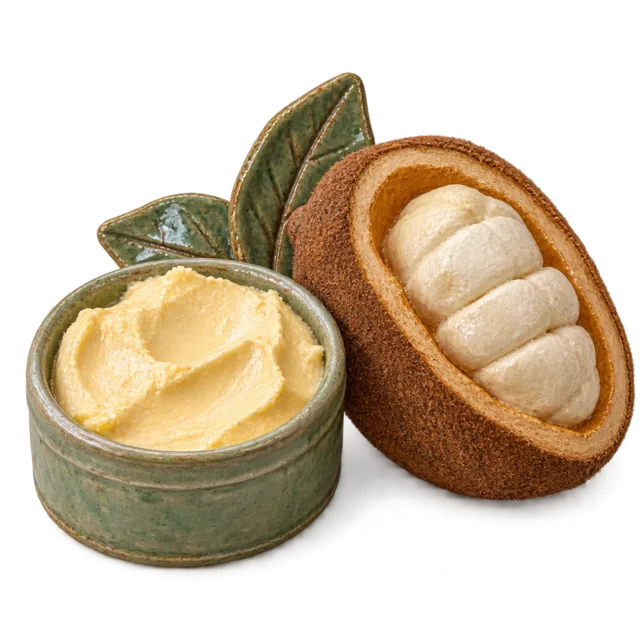
Cupuaçu (Theobroma grandiflorum) is a close cousin of the cacao tree, and its fragrant, tangy pulp is a favourite in juices, ice creams and sweets across northern Brazil. The seeds are rich in a pale, soft fat that melts at around 30°C. Brazil's agricultural research agency, Embrapa, notes that this seed fat is widely used by the cosmetics industry, and cupuaçu butter now turns up in many Brazilian lip balms, body butters and hair products.
You'll need
- cupuaçu butter, from a labelled cosmetic producta pea-sized amount
- a lip balm with SPF 30 or higher, for outdoors
How it's made
- 1Patch test first, as the American Academy of Dermatology advises for new skin products: dab a little on your inner arm or the bend of your elbow twice a day for 7 to 10 days, and don't use it if you get redness, itching or swelling. A home patch test can't rule out an allergy. If you've ever reacted to cupuaçu, don't use it; if you're allergic to cocoa or cocoa butter, ask a doctor first.
- 2Choose a plain, fragrance-free product and read the label: dermatologists advise avoiding fragrance and cinnamon, citrus, mint or peppermint flavourings on dry, chapped lips.
- 3With clean hands, take a pea-sized amount with a clean spatula or fingertip rather than dipping in repeatedly. It's firm in the tub but melts at around body temperature, so warm it between your fingertips.
- 4Smooth a thin layer over dry lips several times a day and before bed, or press it onto dry patches of skin after a bath or shower. Keep it away from your eyes and off broken or irritated skin.
- 5If it burns, stings or tingles, wipe it off and stop: the AAD explains that means it's irritating your lips, not 'working'.
- 6It isn't a sunscreen. Lips burn too, so before going outdoors use a non-irritating lip balm with SPF 30 or higher (zinc oxide or titanium dioxide) and reapply it every 2 hours.
- 7Try not to lick, bite or pick at your lips. Store the tub as the label says, with the lid closed.
What the evidence says
Cultural practice, not studied in people. The research we found on cupuaçu butter and skin is lab work on skin cells and product-development studies, which don't show it helps dry lips or skin. For chapped lips, the American Academy of Dermatology recommends simple, non-irritating balms with ingredients such as petrolatum, shea butter or ceramides; cupuaçu butter isn't on its list, and that advice doesn't show cupuaçu works. Most chapped lips improve in 2 to 3 weeks with self-care.
A real tradition we can document, but nobody has properly tested it.
Who should skip it
- 🤰 Pregnant or breastfeeding? Check with your midwife or doctor first
- 🧒 Not for children under 12
- 💊 Its safety on the skin in pregnancy and breastfeeding hasn't been studied
- 💊 Not a sunscreen: use an SPF 30+ lip balm outdoors
- 💊 Stop if it burns, stings or tingles on your lips
- 🌼 If you've reacted to cupuaçu products, don't use it. Cupuaçu is in the same plant genus as cacao (Theobroma), but a cross-reaction with cocoa allergy hasn't been documented; if you're allergic to cocoa or cocoa butter, ask a doctor first
- 🌼 Blended balms may contain fragrance or flavourings that irritate lips: read the label
- 🌼 A home patch test can't rule out an allergy
- Chapped lips that haven't improved after 2 to 3 weeks of self-care: see a doctor or dermatologist, as an allergy, a yeast infection or another condition can be the cause
- A dry, scaly or rough patch on your lip that doesn't go away (dermatologists check these, as one cause, actinic cheilitis, can be precancerous)
- A rash that spreads, blisters or keeps itching after you stop using it
- Call 999 (UK) or 911 (US) now if your lips, tongue or throat swell or you have trouble breathing
Sources
- 7 dermatologists' tips for healing dry, chapped lips (American Academy of Dermatology)
- How to test skin care products (American Academy of Dermatology)
- Review of Biological Activities of Some Rare Oils from Amazonian Plants (Metabolites, 2025) (PubMed Central)
- Effect of cupuassu butter on human skin cells (Data Brief, 2018) (PubMed)
- Cupuaçuzeiro (Comunicado Técnico 115) (Embrapa Amazônia Oriental)
- Theobroma grandiflorum (cupuaçu) (Wikipedia)
By the Remedies by Culture editorial team · Last checked 2 October 2026 · Not medical advice, and not medically reviewed.


