
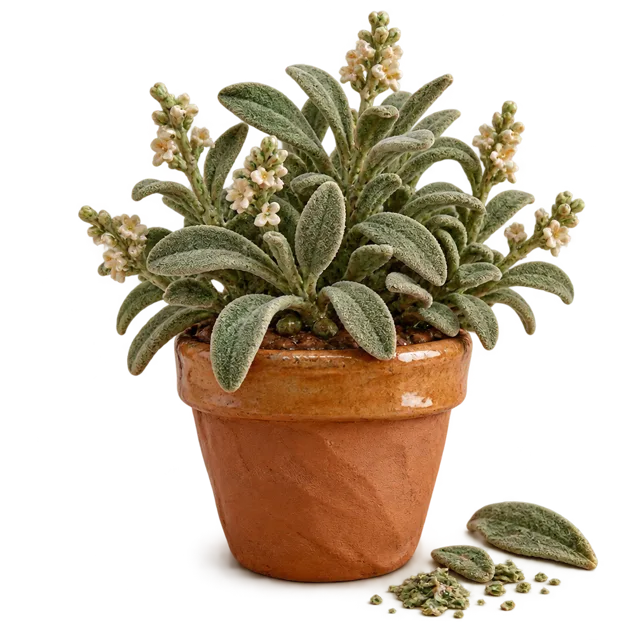
Ethiopian homes and gardens, where damakese is grown as a fragrant household plant · On the skin · 0 min
Damakese (ዳማከሴ)
Damakese leaves (Ethiopian basil relative)
Recorded in Ethiopian plant surveys as a household remedy for fever, headache and other everyday complaints. Cultural practice, not studied in people. No human trials have tested damakese for headaches, and its safety on the skin or when breathed in is unknown. A study in rats found high oral doses of leaf extract affected the liver and kidneys.
Where it comes from
Damakese is a fragrant relative of basil that grows in Ethiopian home gardens. Surveys of traditional plant use in several Ethiopian districts list it among the most often cited household remedy plants, used for fever, headache and other everyday complaints, sometimes by steaming the leaves and breathing in the vapour.
You'll need
- fresh damakese leaves (Ocimum lamiifolium)as used traditionally
How it's made
- 1We don't give a recipe for damakese. Its safety on the skin or when breathed in hasn't been studied in people, and the only safety study we found gave rats leaf extract by mouth, which can't show whether home use is safe.
- 2What people do: Ethiopian plant surveys record the leaves being crushed, boiled or steamed and used for several everyday complaints, including fever and headache.
- 3Don't swallow damakese in any form, don't use damakese essential oil, and keep it away from your eyes.
- 4For a headache, rest somewhere quiet and drink water. Adults can take paracetamol or ibuprofen, following the label, if needed (NHS).
What the evidence says
Cultural practice, not studied in people. No human trials have tested damakese for headaches, and its safety on the skin or when breathed in is unknown. A study in rats found high oral doses of leaf extract affected the liver and kidneys.
A real tradition we can document, but nobody has properly tested it.
Who should skip it
- 🤰 Avoid in pregnancy
- 🧒 For adults only (under 18s should skip it)
- 💊 Don't swallow it: high oral doses affected the liver and kidneys in rats, and its safety in people hasn't been studied
- 💊 Don't use it in pregnancy or while breastfeeding, or on children
- 💊 Keep it away from your eyes and off broken skin
- 🌼 Basil or mint-family (Lamiaceae) allergy
- Call 999 (UK) or 911 (US), or go to A&E/the ER, now for a headache that started suddenly and is extremely painful, or a headache with a fit, numbness or weakness in the face or body, difficulty speaking, balancing, walking or remembering, drowsiness or confusion, loss of vision, a rash that doesn't fade under a glass, a very high temperature, a stiff neck, or bright lights hurting your eyes, or after a head injury in the last 3 months
- Ask for an urgent GP appointment or call NHS 111 (in the US, see a doctor promptly) for a headache with vision or eye problems, one triggered or made worse by coughing, sneezing, bending down or exercise, a headache with vomiting, or jaw pain when eating or a sore, tender scalp
- If you're pregnant or gave birth in the last few weeks, a severe headache that doesn't go away with painkillers, vision problems, sudden swelling of the face, hands or feet, or pain below the ribs can be signs of pre-eclampsia: get urgent medical help now and call your maternity unit (NHS)
- See a GP if you get headaches regularly, or one isn't getting better with self-care
Sources
- Sub-chronic toxicity of the aqueous leaf extract of Ocimum lamiifolium on liver and kidney in rats (2023) (BMC Complementary Medicine and Therapies via PubMed Central)
- Headaches (NHS)
- Tension headaches (NHS)
- Pre-eclampsia (NHS)
- Ethnobotanical study of traditional medicinal plants used by the local people in Habru District, North Wollo Zone, Ethiopia (2024) (PubMed)
- Traditional medicinal plant based remedies for common ailments in Menz Keya Gebreal District, North Shewa Zone, Ethiopia (2025) (PubMed)
- An ethnobotanical survey of indigenous knowledge on medicinal plants used by communities around Ensaro District, North Shewa Zone, Ethiopia (2023) (PubMed)
By the Remedies by Culture editorial team · Last checked 2 October 2026 · Not medical advice, and not medically reviewed.


