
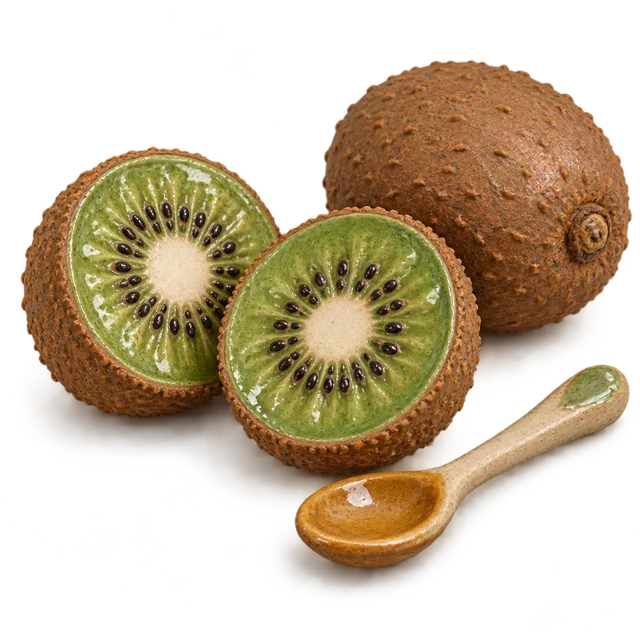
Orchards around the Bay of Plenty, and lunchboxes across New Zealand, where the fruit took its name · Food · 2 min
Kiwifruit
Green kiwifruit
Eaten as an everyday fruit, and recommended between family and friends for keeping things moving. Studied. In a 4-week, partly randomised trial in 79 US adults with chronic constipation, people eating 2 green kiwifruit a day had more complete bowel movements than before the trial, as did people eating prunes or taking psyllium, and side effects were reported least often with kiwifruit. A 2024 review of 7 kiwifruit studies found a small extra increase in bowel movements compared with psyllium. The trials were small and short. Kiwifruit fits the NHS advice to eat more fibre and fruit.
Where it comes from
The fuzzy fruit came to New Zealand from China as 'Chinese gooseberry' early in the 20th century. In 1959 a New Zealand exporter renamed it kiwifruit, after 'Kiwis', the nickname for New Zealanders. Today it's grown across the Bay of Plenty and turns up in lunchboxes and breakfasts all over the country.
You'll need
- ripe green kiwifruit2
- a glass of water1
How it's made
- 1Choose kiwifruit that give slightly when pressed.
- 2Cut them in half and scoop out the flesh with a teaspoon, or peel and slice them.
- 3Eat them with breakfast or as a snack, and drink a glass of water with them.
- 4Adults in the main trial ate 2 green kiwifruit a day for 4 weeks. Give it a few weeks, and keep up other fibre and fluids.
What the evidence says
Studied. In a 4-week, partly randomised trial in 79 US adults with chronic constipation, people eating 2 green kiwifruit a day had more complete bowel movements than before the trial, as did people eating prunes or taking psyllium, and side effects were reported least often with kiwifruit. A 2024 review of 7 kiwifruit studies found a small extra increase in bowel movements compared with psyllium. The trials were small and short. Kiwifruit fits the NHS advice to eat more fibre and fruit.
An EMA well-established-use monograph, or a positive Cochrane/clinical-trial review.
Who should skip it
- 🤰 Fine in normal food amounts in pregnancy
- 🧒 Fine for children in normal food amounts
- 💊 Increase fibre gradually and drink plenty of fluids to avoid wind and bloating
- 🌼 Kiwifruit allergy, which can be serious: don't eat it if you know you're allergic. People with latex allergy can also react to some fruits, including kiwi (MedlinePlus)
- 🌼 An itchy or tingling mouth after eating it can be a sign of allergy: stop eating it and get advice
- Call 999 (UK) or 911 (US), or go to A&E/the ER, now if you have sudden or severe tummy pain, or you can't poo or fart, especially if you're also being sick
- Call 999 (UK) or 911 (US) now if, after eating kiwi, your lips, mouth, throat or tongue suddenly swell, you're struggling to breathe or swallow, your throat feels tight, or you suddenly feel very confused, drowsy or dizzy: this could be anaphylaxis (NHS)
- See a GP if constipation isn't getting better, keeps coming back, or comes with blood in your poo, weight loss without trying, constant tiredness or regular bloating
Sources
- Exploratory comparative effectiveness trial of green kiwifruit, psyllium, or prunes in US patients with chronic constipation (2021) (PubMed)
- Systematic review and meta-analysis: foods, drinks and diets and their effect on chronic constipation in adults (2024) (PubMed)
- Constipation (NHS)
- How to get more fibre into your diet (NHS)
- Kiwifruit (Wikipedia)
- Managing latex allergies at home (MedlinePlus)
- Anaphylaxis (NHS)
By the Remedies by Culture editorial team · Last checked 2 October 2026 · Not medical advice, and not medically reviewed.