
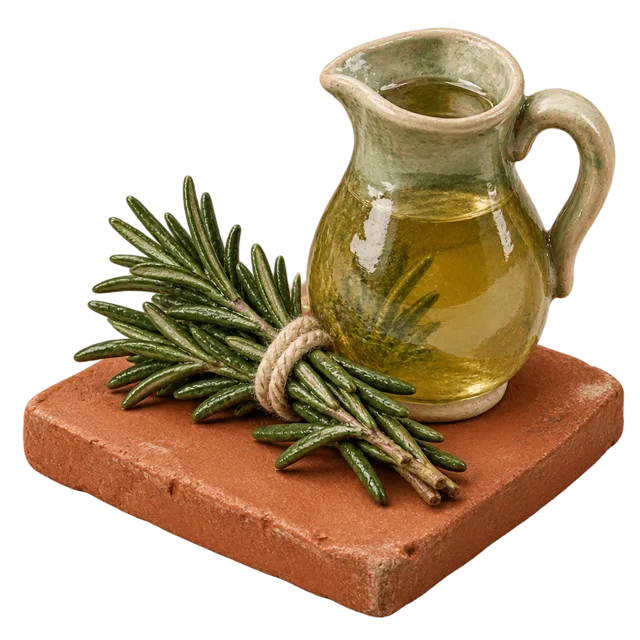
All over Spain, where wild rosemary grows on dry Mediterranean hillsides and is a common kitchen and garden herb · On the skin · 30 min
Agua de romero
Rosemary water hair rinse
Traditionally used as a fragrant final rinse to leave hair feeling fresh and looking glossy; widely believed to make hair grow, which isn't supported. Cultural practice, not studied as a hair rinse. The hugely popular 'rosemary for hair growth' idea rests on a single small 2015 trial in 100 people with pattern hair loss (androgenetic alopecia), which used rosemary oil, not a water rinse, for 6 months and compared it with low-strength minoxidil. It had no placebo group, so it can't show that rosemary itself made a difference, and a 2025 review of hair-loss misinformation lists rosemary oil among popular remedies with limited evidence. Think of it as a fragrant rinse, not a hair-loss remedy; for pattern hair loss the NHS lists minoxidil (and, for men, finasteride) as the main medical options.
Where it comes from
Rosemary (romero) grows wild across Spain's dry hillsides and in many home gardens, and agua de romero, a simple rosemary infusion, is a well-known 'truco de abuela' (grandmother's trick) for hair. Spanish beauty writers describe it being poured over the hair as a final rinse or sprayed onto the scalp. It has had a big revival on social media in recent years.
You'll need
- dried rosemary leaves, or 2 to 3 fresh sprigs1 tbsp
- just-boiled water500 ml
How it's made
- 1Patch test first, the way you'll use it, as the American Academy of Dermatology advises: this final rinse stays on your hair, so dab a little cooled rosemary water on your inner arm and let it dry without rinsing; do this twice a day for 7 to 10 days, and don't use it if you get redness, itching or swelling. A home patch test can't rule out an allergy; if you're allergic to rosemary, don't use it.
- 2Put the rosemary in a clean, heatproof jug, pour over the just-boiled water and leave it to steep for 15 to 20 minutes. Take care with the hot water: if you scald yourself, hold the burn under cool running water for 20 minutes (NHS).
- 3Strain it and let it cool completely, until it feels lukewarm or cool on your wrist. Never pour it on your head while it's hot.
- 4After shampooing (and conditioning, if you use it), tip your head back, close your eyes and slowly pour the rosemary water over your hair as a final rinse, and leave it in. Keep it out of your eyes; if any gets in, rinse them with clean water.
- 5Make it fresh each time, use it the same day and pour any leftover away. Don't use it on a broken, sore or irritated scalp.
- 6Use the dried or fresh herb only. Don't swap in rosemary essential oil: the EMA advises keeping rosemary oil preparations away from the eyes and doesn't recommend them for under-18s, and essential oils must never be swallowed. Don't make your own rosemary-in-oil infusions at home either.
What the evidence says
Cultural practice, not studied as a hair rinse. The hugely popular 'rosemary for hair growth' idea rests on a single small 2015 trial in 100 people with pattern hair loss (androgenetic alopecia), which used rosemary oil, not a water rinse, for 6 months and compared it with low-strength minoxidil. It had no placebo group, so it can't show that rosemary itself made a difference, and a 2025 review of hair-loss misinformation lists rosemary oil among popular remedies with limited evidence. Think of it as a fragrant rinse, not a hair-loss remedy; for pattern hair loss the NHS lists minoxidil (and, for men, finasteride) as the main medical options.
A real tradition we can document, but nobody has properly tested it.
Who should skip it
- 🤰 Avoid in pregnancy
- 🧒 Not for children under 12
- 💊 The EMA says the safety of rosemary preparations, including rosemary baths, in pregnancy and breastfeeding hasn't been established and doesn't recommend them then. The EMA assessed medicines and baths, not cosmetic rinses, and this home rinse hasn't been assessed; skipping it while pregnant or breastfeeding is our own precaution
- 💊 The EMA doesn't recommend rosemary baths for children under 12, or rosemary essential oil preparations for anyone under 18
- 💊 Don't use it on broken or irritated skin or scalp
- 💊 Never swallow rosemary essential oil
- 🌼 Rosemary can cause allergic contact dermatitis (the EMA lists it as a possible side effect); if you've reacted to rosemary on your skin, don't use it
- 🌼 A home patch test can't rule out an allergy
- Patchy hair loss, bald patches, or hair coming out in clumps
- A sore, scaly, crusted, itchy or burning scalp
- Hair loss after starting a new product, medicine or hair treatment
- You're worried about thinning hair: see a GP to find out the cause before trying products or hair clinics
- Call 999 (UK) or 911 (US) now if your lips, tongue or throat swell or you have trouble breathing
Sources
- Rosemary oil vs minoxidil 2% for the treatment of androgenetic alopecia: a randomized comparative trial (Skinmed, 2015) (PubMed)
- A Qualitative Review of Misinformation on Alopecia (Skin Appendage Disord, 2025) (PubMed Central)
- European Union herbal monograph on Rosmarinus officinalis L., folium (rosemary leaf) (European Medicines Agency)
- European Union herbal monograph on Rosmarinus officinalis L., aetheroleum (rosemary oil) (European Medicines Agency)
- How to test skin care products (American Academy of Dermatology)
- Hair loss (NHS)
- Así puedes hacer tu propia agua de romero: el truco de abuela (Trendencias)
- Burns and scalds (NHS)
By the Remedies by Culture editorial team · Last checked 2 October 2026 · Not medical advice, and not medically reviewed.


