Across Iran; henna is grown in Kerman province and much of it is ground in the old stone mills of Yazd · On the skin · 150 min
Hana (حنا)
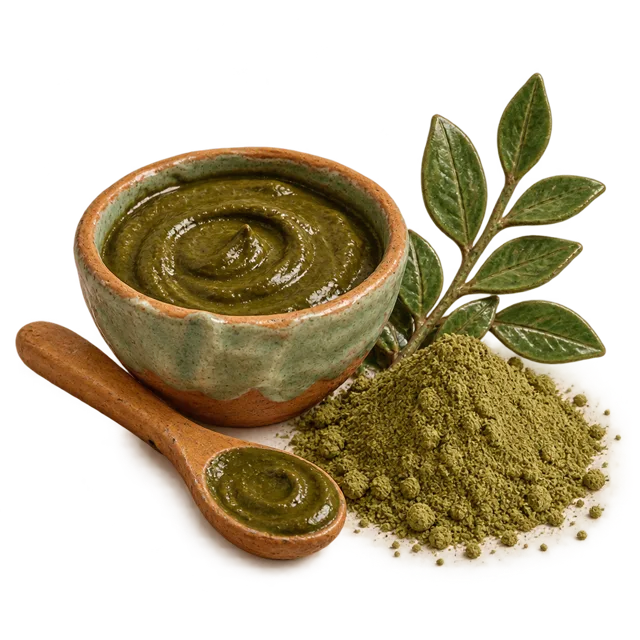
Plain henna hair colour
Traditionally used to colour hair a warm red-brown and to cover grey, and many people say it leaves hair glossy and coated. Cultural practice. That henna colours hair is well established: the FDA lists henna as an approved colour additive for hair dyes. Claims that it conditions, strengthens or thickens hair haven't been tested, and it isn't shown to make hair grow. A review of side effects found pure (red) henna generally safe on the skin, with rare allergies; 'black henna' with added PPD causes allergy far more often. Henna can trigger serious breakdown of red blood cells (haemolysis) in people with G6PD deficiency: a systematic review found henna was the only herbal product with clear evidence of this, and the most serious reported cases were in babies and children.
Where it comes from
Henna (hana in Persian) has been used in Iran for centuries to colour hair, beards, hands and nails. Encyclopaedia Iranica records that the best henna was said to come from Kerman, and that traders carried the dried leaves to Yazd to be ground in special stone mills (there were around ninety of them in a 1987 study) and sold as hana-ye Yazd. Many people darkened hennaed hair afterwards with an indigo paste, and the pair is still sold together as rang o hana.
You'll need
- pure henna powder from a labelled hair-dye product whose only ingredient is henna (Lawsonia inermis)50 to 100 g, depending on hair length
- warm (not hot) waterenough for a thick, yogurt-like paste
- disposable gloves, a shower cap and an old towel1 each
- petroleum jellya little, for the hairline
How it's made
- 1Check the label: use only pure plant henna sold as a hair dye. Never use anything called 'black henna' or a product that promises a fast black or dark colour: these often contain PPD (p-phenylenediamine), which can cause severe skin reactions (FDA). Henna is approved in the US only as a hair dye, not for colouring the skin.
- 2Patch test every time before you colour your hair, as the FDA advises for all hair dyes, following your product's own test instructions (choose a product that gives them). An orange stain on the spot is normal; redness, itching or swelling is not, so don't use it. Even with no reaction to the test, a reaction to the dye is still possible (FDA). Test it the way you'll use it: the American Academy of Dermatology's general advice is to use the normal amount and leave it on for as long as you normally would; your dye's own instructions come first.
- 3Wait at least 14 days after bleaching, relaxing or perming your hair, don't scratch or brush your scalp hard for 3 days before, and don't use it if your scalp is irritated, sunburnt or damaged (FDA). Strand test too: colour a few hairs from the back of your head first, as the NHS also advises in pregnancy. On chemically treated hair the colour may not take evenly or may turn an unexpected shade.
- 4In a clean bowl, stir the powder with warm water into a smooth, thick paste. Make only what you need for one session and throw away any leftover.
- 5Put on gloves, protect your clothes, and smooth petroleum jelly along your hairline and ears to keep the dye off your skin.
- 6Work the paste through clean, damp hair from roots to ends. Keep it away from your eyes, and never use it on eyebrows or eyelashes.
- 7Cover with a shower cap and leave it for the time your product's instructions give, and never longer (FDA).
- 8Rinse with lukewarm water until the water runs clear, then use conditioner. Wash the bowl, spoon and towels straight away, and keep the paste away from babies and children.
- 9Expect orange-red to auburn tones depending on your starting colour; the shade usually deepens over a day or two and with repeat applications. It's a colour, not a hair-growth treatment.
What the evidence says
Cultural practice. That henna colours hair is well established: the FDA lists henna as an approved colour additive for hair dyes. Claims that it conditions, strengthens or thickens hair haven't been tested, and it isn't shown to make hair grow. A review of side effects found pure (red) henna generally safe on the skin, with rare allergies; 'black henna' with added PPD causes allergy far more often. Henna can trigger serious breakdown of red blood cells (haemolysis) in people with G6PD deficiency: a systematic review found henna was the only herbal product with clear evidence of this, and the most serious reported cases were in babies and children.
A real tradition we can document, but nobody has properly tested it.
Who should skip it
- 🤰 Pregnant or breastfeeding? Check with your midwife or doctor first
- 🧒 For adults only (under 18s should skip it)
- 💊 G6PD deficiency: don't use henna. It can cause haemolysis (breakdown of red blood cells), which has been life-threatening in children; being an adult or having no reaction to a skin test doesn't remove this risk. G6PD deficiency is most common in people with roots in parts of Africa, Asia, the Mediterranean and the Middle East; if you're not sure, ask your doctor
- 💊 Never put henna on babies or children, and keep the paste and anything with paste on it away from them
- 💊 In pregnancy, the NHS mentions semi-permanent pure vegetable dye such as henna as a safer alternative to chemical hair dyes, and advises a strand test, gloves and never going over the maker's maximum time. We still flag caution: ask your midwife or doctor if you're unsure, and henna isn't a pregnancy remedy
- 💊 Never use 'black henna' or any product containing PPD; a past reaction to a black henna tattoo can make reactions to hair dyes more likely
- 💊 Keep it out of your eyes and never use it on eyebrows or eyelashes
- 💊 Colour over chemically treated hair can be uneven or an unexpected shade: strand test first and tell your hairdresser before any later perm, relaxer or chemical colour
- 🌼 Pure henna allergy is rare but does happen, from itchy rashes to immediate reactions; if you've reacted to henna before, don't use it
- 🌼 If you've reacted to hair dye or a black henna tattoo, ask a doctor before using any 'henna' product
- 🌼 A home patch test can't rule out an allergy
- Call 999 (UK) or 911 (US) now if your lips, tongue or throat swell or you have trouble breathing
- Get urgent medical help (NHS 111 or your doctor, or A&E if severe) if, in the days after using henna, you or a child become pale, very tired or short of breath, or have yellow skin or eyes or dark urine
- Blistering, oozing or swelling of the scalp, face or ears after colouring
- Patchy hair loss, hair loss after a new product, or a sore, scaly or crusted scalp
- A rash that spreads, blisters or keeps itching after you stop using it
Sources
- Henna (Encyclopaedia Iranica)
- Temporary tattoos, henna/mehndi, and 'black henna': fact sheet (US Food and Drug Administration)
- Hair dyes (US Food and Drug Administration)
- Side-effects of henna and semi-permanent 'black henna' tattoos: a full review (Contact Dermatitis, 2013) (PubMed)
- Adverse effects of herbal or dietary supplements in G6PD deficiency: a systematic review (Br J Clin Pharmacol, 2017) (PubMed)
- Glucose-6-phosphate dehydrogenase deficiency (MedlinePlus Genetics)
- Using hair dye in pregnancy: is it safe? (NHS)
- How to test skin care products (American Academy of Dermatology)
By the Remedies by Culture editorial team · Last checked 2 October 2026 · Not medical advice, and not medically reviewed.