
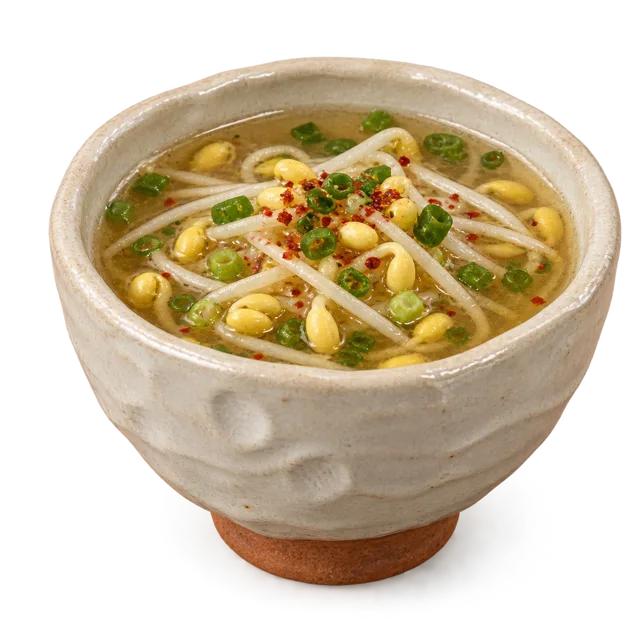
Home kitchens across South Korea, where it's one of the most everyday soups · Food · 30 min
Kongnamul-guk (콩나물국)
Soybean sprout soup
Traditionally eaten hot (often with a spoonful of chilli) by someone coming down with a cold, as a light, easy soup. Cultural practice, not studied: kongnamul-guk itself hasn't been tested for colds. Hot soup is a gentle way to get fluids and food in, which fits NHS self-care advice for colds, but there's no good evidence that it shortens a cold or that soybean sprouts do anything special for one.
Where it comes from
Kongnamul (soybean sprouts) are cheap, available all year round and turn up in countless Korean dishes, and kongnamul-guk is one of the most frequently eaten soups in Korean homes. When a cold starts, many Koreans reach for a bowl of it, often made spicy with gochugaru, and a Korean health news site lists it first among the hot soups people eat with a cold.
You'll need
- soybean sprouts (kongnamul)250 g
- dried anchovies for the broth (or use water)6 to 8
- garlic clove, thinly sliced1
- spring onion, chopped1
- waterabout 1.4 litres (6 cups)
- salt and pepperto taste
- gochugaru (Korean chilli flakes), optional1 tsp
How it's made
- 1Boil the water with the anchovies and garlic, uncovered, for 10 minutes, then lift them out.
- 2Rinse the soybean sprouts a couple of times and discard any floating bean skins.
- 3Add the sprouts and 1 teaspoon of salt, cover and boil for 7 to 8 minutes until the sprouts are fully cooked and tender all the way through. Don't serve them raw or lightly cooked: the FDA notes sprouts can carry Salmonella, Listeria and E. coli, and says children, older adults, pregnant women and anyone with a weakened immune system should avoid raw or lightly cooked sprouts. Korean cooks keep the lid on so the raw-bean smell doesn't linger.
- 4Season with salt and pepper, add the spring onion and, if you like, a pinch of gochugaru for a spicy version.
- 5Let it cool to comfortably warm before eating. Cool any leftovers within 1 to 2 hours, keep them in the fridge, eat them within 2 days and reheat until steaming hot all the way through (NHS).
What the evidence says
Cultural practice, not studied: kongnamul-guk itself hasn't been tested for colds. Hot soup is a gentle way to get fluids and food in, which fits NHS self-care advice for colds, but there's no good evidence that it shortens a cold or that soybean sprouts do anything special for one.
A real tradition we can document, but nobody has properly tested it.
Who should skip it
- 🤰 Fine in normal food amounts in pregnancy
- 🧒 Fine for children in normal food amounts
- 💊 Can be salty; season lightly if you've been told to limit salt
- 🌼 Soya allergy (soybean sprouts)
- 🌼 Fish allergy (anchovy broth; use water instead)
- 🌼 Onion and garlic (allium) intolerance
- Cold symptoms that get worse, or don't improve after 10 days
- A high temperature for more than 3 days, a very high temperature, or you feel hot, cold or shivery
- A cough that lasts more than 3 weeks
- You have a long-term condition or a weakened immune system
- Call 999 (UK) or 911 (US) now if you have sudden chest pain, severe difficulty breathing (gasping, choking or unable to get words out), are coughing up blood, or become confused or very hard to wake
- Get urgent advice (NHS 111 or your doctor) if you feel short of breath or very unwell
Sources
- Kongnamul guk (soybean sprout soup) (The Korea Herald)
- 감기 증상 완화에 좋은 음식 7 (7 foods for easing cold symptoms) (Kormedi)
- Kongnamul (Wikipedia)
- Common cold (NHS)
- Food allergy (NHS)
- Storing and reheating food (NHS)
- Selecting and serving produce safely (US Food and Drug Administration)
By the Remedies by Culture editorial team · Last checked 2 October 2026 · Not medical advice, and not medically reviewed.


