
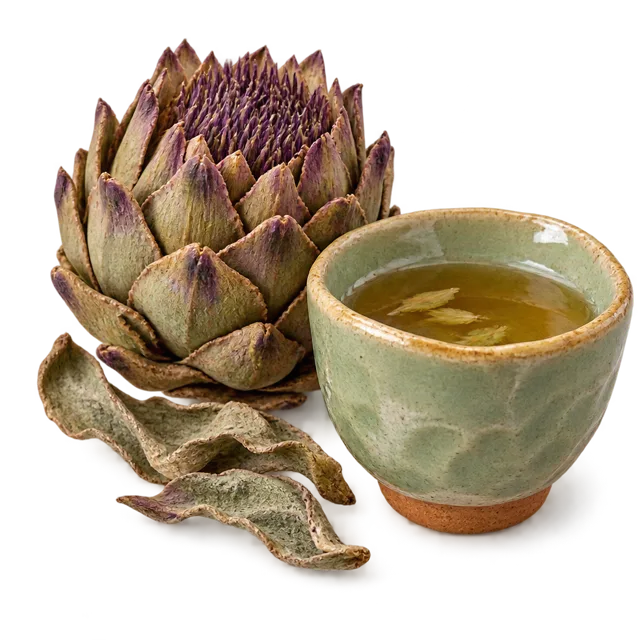
Đà Lạt in Vietnam's cool Central Highlands, where artichokes are grown and dried for tea · Tea · 10 min
Trà atisô
Artichoke tea
Traditionally drunk after meals to ease a full, heavy stomach and bloating. Traditional use. The EMA recognises artichoke leaf tea as a traditional herbal medicine for indigestion with a feeling of fullness, bloating and wind, based on long use. This recipe uses the adult amount from its monograph (1.5 g in 150 ml). The EMA's assessment covers the leaf only, so teas made from the flowers, stems or roots are outside it. A 6-week trial of a concentrated artichoke leaf extract in 247 adults with indigestion found modestly more improvement than placebo, but it used an extract, not tea, so this drink hasn't been properly tested.
Where it comes from
Vietnam's Ministry of Industry and Trade magazine says the French brought artichokes to Vietnam around the 1940s, and they're now grown most widely around Đà Lạt. The flowers are eaten as a vegetable, and the leaves, stems, roots and flowers are dried and sold as trà atisô tea bags, described locally as a 'cooling' tea.
You'll need
- artichoke leaf tea (Cynara cardunculus, also sold as Cynara scolymus), from a pack labelled as leaf only: not the sweetened instant kind, and not flower or root blends1.5 g (1 tea bag, or weigh loose leaf)
- just-boiled water150 ml
How it's made
- 1Pour the just-boiled water over the tea bag or leaves, cover and leave for 5 to 10 minutes.
- 2Strain, and let it cool until comfortably warm. It's quite bitter; that's normal.
- 3Sip it slowly after a meal.
- 4Adults only. If indigestion lasts more than 2 weeks, or gets worse, stop and see a doctor or pharmacist.
What the evidence says
Traditional use. The EMA recognises artichoke leaf tea as a traditional herbal medicine for indigestion with a feeling of fullness, bloating and wind, based on long use. This recipe uses the adult amount from its monograph (1.5 g in 150 ml). The EMA's assessment covers the leaf only, so teas made from the flowers, stems or roots are outside it. A 6-week trial of a concentrated artichoke leaf extract in 247 adults with indigestion found modestly more improvement than placebo, but it used an extract, not tea, so this drink hasn't been properly tested.
Has an EMA traditional-use monograph: long, documented use, but not proven in trials.
Who should skip it
- 🤰 Avoid in pregnancy
- 🧒 For adults only (under 18s should skip it)
- 💊 Don't use it if you have a blocked bile duct, gallstones, inflammation of the bile ducts, liver disease or any other bile-duct problem (EMA)
- 💊 The EMA doesn't recommend it in pregnancy or while breastfeeding, or for children under 12
- 💊 It can occasionally cause mild diarrhoea with cramps, nausea or heartburn (EMA)
- 💊 Instant artichoke drinks are often mostly sugar; choose plain leaf tea
- 🌼 Don't use it if you're allergic to artichoke or the daisy family (Asteraceae), such as chamomile, ragweed or marigold (EMA)
- Call 999 (UK) or 911 (US), or go to A&E/the ER, now if tummy pain comes on very suddenly or is severe, it hurts to touch your tummy, you're vomiting blood or vomit that looks like ground coffee, your poo is bloody or black, sticky and very smelly, or you can't poo or fart
- Ask for an urgent GP appointment or call NHS 111 (in the US, see a doctor promptly) if a stomach ache gets much worse, keeps coming back, or comes with bloating that won't go away, trouble swallowing food, weight loss without trying, or bleeding from your bottom
- See a GP if indigestion or bloating keeps coming back, or you're often bloated
- See a doctor straight away if your skin or the whites of your eyes turn yellow
Sources
- Cynarae folium (artichoke leaf) herbal monograph (EMA)
- Efficacy of artichoke leaf extract in the treatment of patients with functional dyspepsia: a six-week placebo-controlled, double-blind, multicentre trial (2003) (PubMed)
- Indigestion (NHS)
- Bloating (NHS)
- Vietnamese tea (Wikipedia)
- Atisô: dược liệu vàng trên đất Lâm Đồng (Tạp chí Công Thương (Ministry of Industry and Trade magazine))
By the Remedies by Culture editorial team · Last checked 2 October 2026 · Not medical advice, and not medically reviewed.


