
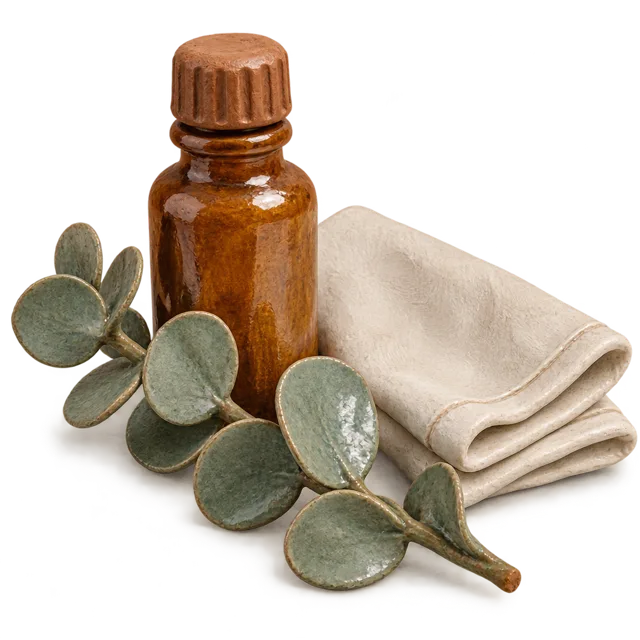
Australian homes, where a bottle of eucalyptus oil is a common sight in the bathroom cabinet or laundry · Steam · 5 min
Eucalyptus oil on a hanky
Eucalyptus oil inhaled from a tissue
Traditionally breathed in from a hanky or tissue to ease a stuffy nose and a chesty cough with a cold. Cultural practice, not studied: drops on a tissue haven't been tested. Separately, the EMA recognises eucalyptus oil breathed in with steam (drops in a bowl of just-boiled water) as a traditional herbal medicine for the relief of cough associated with a cold, based on long use rather than strong trials; that assessment doesn't cover the tissue method or a blocked nose. Eucalyptus oil is poisonous if swallowed: 2 to 3 ml can make a child drowsy and unsteady, and 5 ml or more can cause severe poisoning (Royal Children's Hospital Melbourne). Eucalyptus is the oil most often involved in essential oil poisoning calls in New South Wales, especially in winter.
Where it comes from
Australia's eucalyptus oil industry began in 1852, when Melbourne pharmacist Joseph Bosisto set up a still near Dandenong in Victoria, and the oil is still sold everywhere from pharmacies to supermarkets. In many Australian homes a few drops on a hanky is a familiar winter habit, and the same bottle often does double duty in the laundry.
You'll need
- a eucalyptus oil product whose label or leaflet gives directions for inhaling it from a tissue or handkerchief, with a child-resistant capas its label or leaflet directs
- a clean tissue or handkerchief1
How it's made
- 1Adults only. Use only a eucalyptus oil product whose label or leaflet specifically gives directions for inhaling it from a tissue or handkerchief, and follow those directions for how many drops to use, how long and how often. If the label doesn't describe this tissue method (many bottles are sold for cleaning, laundry or steam only), don't use it this way.
- 2Put the oil on a clean tissue or handkerchief as the label directs, hold it a little way from your nose and breathe in gently. Don't press the oily tissue against your nose or face, and keep it away from your eyes.
- 3Don't put the oil on broken or irritated skin, and wash your hands after handling it (EMA).
- 4Never swallow eucalyptus oil, and don't put it in drinks or on food. Screw the cap back on straight away and store the bottle where children can't see or reach it.
- 5Throw the tissue away in a lidded bin afterwards, not where a child or pet could chew it.
- 6If symptoms last more than a week, or you get breathlessness, a fever or coughing up thick discoloured phlegm, see a doctor or pharmacist (EMA).
What the evidence says
Cultural practice, not studied: drops on a tissue haven't been tested. Separately, the EMA recognises eucalyptus oil breathed in with steam (drops in a bowl of just-boiled water) as a traditional herbal medicine for the relief of cough associated with a cold, based on long use rather than strong trials; that assessment doesn't cover the tissue method or a blocked nose. Eucalyptus oil is poisonous if swallowed: 2 to 3 ml can make a child drowsy and unsteady, and 5 ml or more can cause severe poisoning (Royal Children's Hospital Melbourne). Eucalyptus is the oil most often involved in essential oil poisoning calls in New South Wales, especially in winter.
A real tradition we can document, but nobody has properly tested it.
Who should skip it
- 🤰 Avoid in pregnancy
- 🧒 For adults only (under 18s should skip it)
- 💊 Never swallow it: eucalyptus oil is highly toxic by mouth, and 2 to 3 ml can make a child drowsy, dizzy and unsteady (Royal Children's Hospital Melbourne)
- 💊 If anyone swallows eucalyptus oil, act straight away: in the UK call 999 or go to A&E (NHS); in Australia call the Poisons Information Centre on 13 11 26; in the US call Poison Control on 1-800-222-1222. Call 000 or 911 if they are drowsy, having a seizure or struggling to breathe. Don't make them sick, and don't give them anything to eat or drink (NHS)
- 💊 The EMA says it must not be used for children under 2 (it can cause a spasm of the voice box) or children with a history of seizures
- 💊 The EMA doesn't recommend it in pregnancy or breastfeeding because its safety hasn't been established
- 💊 Keep it away from your eyes and off broken or irritated skin
- 🌼 Don't use it if you're allergic to eucalyptus oil or cineole; allergic reactions, including severe ones, have been reported (EMA)
- Symptoms last more than a week while you're using it, or get worse
- You become breathless, develop a fever, or cough up thick discoloured phlegm
- Cold symptoms that don't improve after 10 days, or a cough that lasts more than 3 weeks
- Call 999 (UK), 911 (US) or 000 (Australia) now if you have severe difficulty breathing, sudden chest pain, are coughing up blood, have swelling of the lips, tongue or throat, or become confused or very hard to wake
- If anyone swallows eucalyptus oil: call 999 or go to A&E now (UK); call 13 11 26 (Australia) or Poison Control on 1-800-222-1222 (US), and 000 or 911 if they are drowsy, fitting or struggling to breathe. Don't make them sick or give them anything to eat or drink
- Get urgent advice (NHS 111 or your doctor) if you feel very unwell or short of breath, or you have a long-term condition or a weakened immune system
Sources
- Eucalypti aetheroleum (eucalyptus oil) herbal monograph (EMA)
- European Union herbal monograph on eucalyptus oil (Revision 1) (EMA)
- Eucalyptus oil poisoning: clinical practice guideline (The Royal Children's Hospital Melbourne)
- Essential oil exposures in Australia: analysis of cases reported to the NSW Poisons Information Centre (Med J Aust, 2020) (Medical Journal of Australia)
- Common cold (NHS)
- Eucalyptus oil (Wikipedia)
- Poisoning (NHS)
By the Remedies by Culture editorial team · Last checked 2 October 2026 · Not medical advice, and not medically reviewed.


