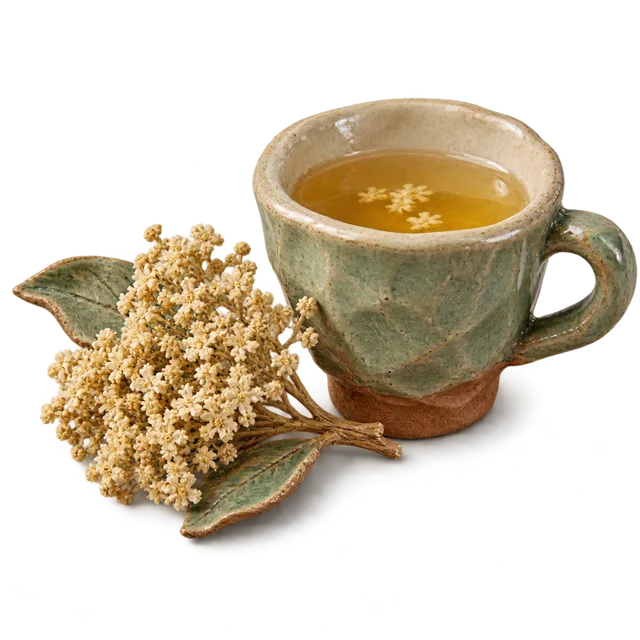
Austrian homes, where dried elderflower and lime-blossom teas are familiar standbys for a cold · Tea · 10 min
Holunderblütentee
Elderflower tea
Traditionally drunk at the first sniffles of a cold, as a warming 'sweating' tea. The EMA recognises elderflower tea as a traditional herbal medicine for the relief of early symptoms of a common cold, for adolescents over 12 and adults, based on long use rather than clinical trials. It isn't recommended for children under 12 or in pregnancy and breastfeeding. NCCIH notes there isn't enough evidence on elder for flu.
Where it comes from
Elder (Holunder) is native across Europe, growing in hedgerows, woodland edges and waste ground, and its flat clusters of creamy flowers bloom in May and June. Austrian public radio still lists elderflower and lime-blossom tea among the familiar household standbys for a cold, often as part of an old 'sweating' routine with a hot bath and heavy blankets, which we leave out.
You'll need
- dried elderflowers (Sambucus nigra), from a labelled pharmacy or tea product, weighed because spoon sizes vary2 to 5 g
- just-boiled water150 ml
How it's made
- 1Use dried elderflowers from a pharmacy or a labelled tea product rather than picking them yourself, and follow its leaflet if it has one.
- 2Pour the just-boiled water over the dried flowers, cover and leave for 5 to 10 minutes.
- 3Strain and let it cool to comfortably warm before you sip it.
- 4Adults only: up to 3 cups a day at the first signs of a cold. (The EMA monograph covers adolescents over 12 too, but we keep medicinal brews to adults.) If symptoms last more than a week or get worse while you're using it, see a doctor or pharmacist.
- 5Only the dried flowers: never eat raw or unripe elderberries, or use the leaves or stems.
What the evidence says
The EMA recognises elderflower tea as a traditional herbal medicine for the relief of early symptoms of a common cold, for adolescents over 12 and adults, based on long use rather than clinical trials. It isn't recommended for children under 12 or in pregnancy and breastfeeding. NCCIH notes there isn't enough evidence on elder for flu.
Has an EMA traditional-use monograph: long, documented use, but not proven in trials.
Who should skip it
- 🤰 Avoid in pregnancy
- 🧒 For adults only (under 18s should skip it)
- 💊 The EMA doesn't recommend it in pregnancy or breastfeeding because its safety hasn't been established; don't use it medicinally then
- 💊 Raw or unripe elderberries and the leaves and stems of the elder plant contain cyanide-producing substances that can cause nausea, vomiting and severe diarrhoea (NCCIH)
- 💊 If you take regular medicines, check with a pharmacist before using herbal products
- 🌼 Don't use it if you're allergic to elder (Sambucus)
- Symptoms last more than a week while you're using it, or get worse
- Cold symptoms that get worse, or don't improve after 10 days
- A high temperature for more than 3 days, a very high temperature, or you feel hot, cold or shivery
- A cough that lasts more than 3 weeks
- Call 999 (UK) or 911 (US) now if you have sudden chest pain, severe difficulty breathing (gasping, choking or unable to get words out), are coughing up blood, or become confused or very hard to wake
- Get urgent advice (NHS 111 or your doctor) if you feel short of breath or very unwell, or you have a long-term condition or a weakened immune system
Sources
- Sambuci flos (elder flower) herbal monograph (EMA)
- European Union herbal monograph on Sambucus nigra L., flos (Revision 1) (EMA)
- European elder (NCCIH)
- Common cold (NHS)
- Die besten Hausmittel gegen Erkältung (ORF Radio Niederösterreich)
- Sambucus nigra (Wikipedia)
By the Remedies by Culture editorial team · Last checked 2 October 2026 · Not medical advice, and not medically reviewed.