Southern and central Chile, where wild rosehip bushes grow along roadsides and farmland from the Santiago region down to Aysén · On the skin · 2 min
Aceite de rosa mosqueta
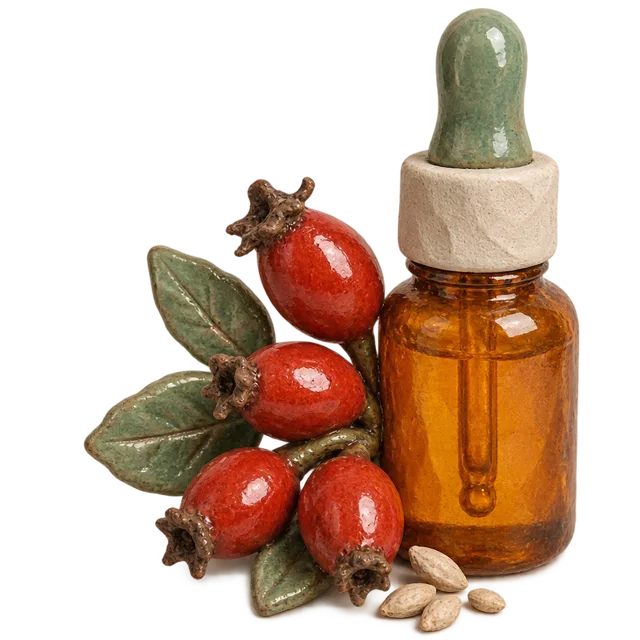
Chilean rosehip seed oil
Used in many Chilean households as a light face and body oil for dry skin; widely believed to fade scars and stretch marks, though that isn't established. Cultural practice, not well studied. There are no good trials of rosehip oil as a moisturiser for dry skin. For scars, a 2024 review found some evidence that rosehip may improve post-surgical scars, but too few good-quality studies to recommend it. We found no good evidence that it fades stretch marks, wrinkles or dark spots. (The AAD notes that some other oils tested on stretch marks, such as almond oil, cocoa butter and olive oil, didn't work; that's about those oils, not rosehip.) Allergic contact dermatitis to rosehip oil has been reported.
Where it comes from
The rosehip bushes that Chileans call rosa mosqueta (mainly Rosa rubiginosa and Rosa canina) came from Europe with the Spanish and now grow wild across much of the country. Families in the rural south have long gathered the red hips in late summer for jams, teas and juices. Since the 1970s Chile has become one of the world's main producers of rosehip seed oil, which is pressed from the tiny seeds and sold mostly as a cosmetic oil.
You'll need
- rosehip seed oil (aceite de rosa mosqueta), from a labelled cosmetic product2 to 3 drops
How it's made
- 1Patch test first, as the American Academy of Dermatology advises for new skin products: dab a little on your inner arm or the bend of your elbow twice a day for 7 to 10 days, and don't use it if you get redness, itching or swelling. A home patch test can't rule out an allergy; if you've reacted to rosehip oil before, don't use it.
- 2Check the label: use a product sold for use on the skin, and stop using it once it's past its date.
- 3Wash your hands, then warm 2 or 3 drops between your fingertips.
- 4Press it gently onto clean, slightly damp skin on dry patches of your face or body, ideally after a bath or shower. Keep it away from your eyes and off broken, sunburnt or irritated skin.
- 5Put the cap straight back on and store the bottle as the label says. If it smells rancid or 'off', or is past its date, throw it away.
- 6It isn't a sunscreen: still use a broad-spectrum sunscreen (SPF 30 or more) in strong sun.
What the evidence says
Cultural practice, not well studied. There are no good trials of rosehip oil as a moisturiser for dry skin. For scars, a 2024 review found some evidence that rosehip may improve post-surgical scars, but too few good-quality studies to recommend it. We found no good evidence that it fades stretch marks, wrinkles or dark spots. (The AAD notes that some other oils tested on stretch marks, such as almond oil, cocoa butter and olive oil, didn't work; that's about those oils, not rosehip.) Allergic contact dermatitis to rosehip oil has been reported.
A real tradition we can document, but nobody has properly tested it.
Who should skip it
- 🤰 Pregnant or breastfeeding? Check with your midwife or doctor first
- 🧒 Not for children under 12
- 💊 Its safety on the skin in pregnancy and breastfeeding hasn't been studied
- 💊 Not a substitute for sunscreen
- 💊 Don't use an oil that smells rancid or is past its date
- 🌼 Allergic contact dermatitis to rosehip (rosa mosqueta) oil has been reported; if you've reacted to it or to rose-based cosmetics, don't use it
- 🌼 A home patch test can't rule out an allergy
- A rash that spreads, blisters or keeps itching after you stop using it
- Signs of infection: skin that's hot, swollen, painful or oozing
- A mole or dark patch that is new, changing shape or colour, bleeding or itchy
- Get urgent advice (NHS 111 or your doctor) if a scar is swollen, painful, feels warm or has pus coming out of it; see a doctor if a scar is painful or bothering you
- Call 999 (UK) or 911 (US) now if your lips, tongue or throat swell or you have trouble breathing
Sources
- Rosehip extract and wound healing: A review (J Cosmet Dermatol, 2024) (PubMed)
- Anti-Inflammatory and Skin Barrier Repair Effects of Topical Application of Some Plant Oils (Int J Mol Sci, 2017) (PubMed Central)
- Allergic contact dermatitis caused by "Rosa mosqueta" oil (Contact Dermatitis, 2018) (PubMed)
- Stretch marks: Why they appear and how to get rid of them (American Academy of Dermatology)
- Scars (NHS)
- How to test skin care products (American Academy of Dermatology)
- Generalidades de la rosa mosqueta (Boletín INIA) (Instituto de Investigaciones Agropecuarias (INIA), Chile)
By the Remedies by Culture editorial team · Last checked 2 October 2026 · Not medical advice, and not medically reviewed.