South Africa, where marula trees grow in the woodland and bushveld from Limpopo down to KwaZulu-Natal · On the skin · 3 min
Marula oil
Marula kernel oil for dry skin and cuticles
Traditionally applied to keep skin healthy, and used as a rich oil for dry skin and hands. Cultural practice, studied only a little. In one small South African study, marula oil didn't irritate the skin of 20 women and helped dry skin hold moisture in instrument tests, a short-term moisturising effect like other rich oils; that doesn't mean it can't irritate anyone's skin. There are no studies on nails, and no good evidence for wider claims. For nails, the AAD and NHS advise moisturising nails and fingertips, wearing gloves for wet work and leaving cuticles alone.
Where it comes from
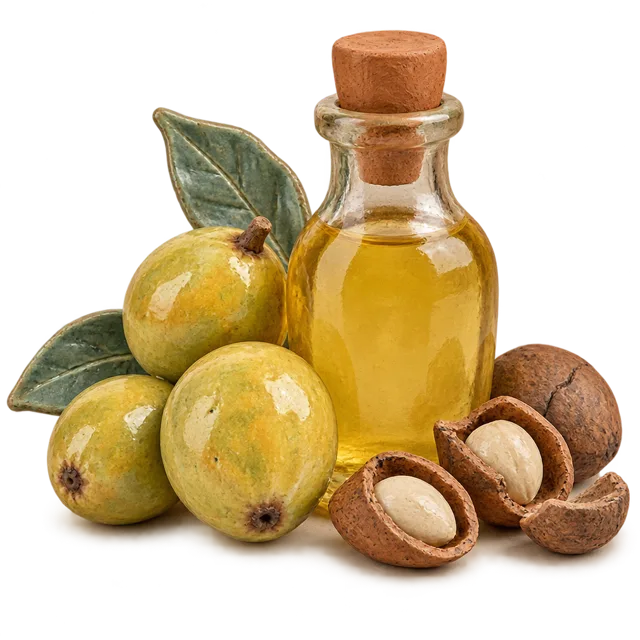
The marula tree (Sclerocarya birrea), a member of the cashew family, grows across the warm woodland of southern Africa, and its hard stones hold small, edible kernels. Ethnobotanical records cited by South African researchers say that Zulu people, among others, applied the kernel oil to keep their skin healthy, and in many places it is also a cooking oil. Marula oil is now a popular ingredient in skin and hair products sold around the world.
You'll need
- marula oil, from a labelled cosmetic product2 to 4 drops
How it's made
- 1If you have a tree-nut allergy, ask a doctor before using it: marula oil is pressed from a nut kernel.
- 2Patch test first, as the American Academy of Dermatology advises for new skin products: dab a little on your inner arm or the bend of your elbow twice a day for 7 to 10 days, and don't use it if you get redness, itching or swelling. A home patch test can't rule out an allergy.
- 3Wash and dry your hands. For dry skin, warm 2 or 3 drops between your palms and smooth them over dry patches straight after a bath or shower, while your skin is still slightly damp.
- 4For dry cuticles and nails, put a drop on each hand and massage it into the nails and the skin around them. Leave your cuticles alone: dermatologists advise not cutting or pushing them back, because they protect the nail.
- 5Keep it away from your eyes and off broken or irritated skin, and don't use it on a sore, red or swollen nail fold.
- 6Close the bottle and store it as the label says; throw it away if it smells rancid or is past its date. It isn't a sunscreen.
What the evidence says
Cultural practice, studied only a little. In one small South African study, marula oil didn't irritate the skin of 20 women and helped dry skin hold moisture in instrument tests, a short-term moisturising effect like other rich oils; that doesn't mean it can't irritate anyone's skin. There are no studies on nails, and no good evidence for wider claims. For nails, the AAD and NHS advise moisturising nails and fingertips, wearing gloves for wet work and leaving cuticles alone.
A real tradition we can document, but nobody has properly tested it.
Who should skip it
- 🤰 Pregnant or breastfeeding? Check with your midwife or doctor first
- 🧒 Not for children under 12
- 💊 Its safety on the skin in pregnancy and breastfeeding hasn't been studied
- 💊 Not a sunscreen
- 🌼 Tree-nut allergy: marula oil comes from a nut kernel, so ask a doctor first. As a precaution (not a documented cross-reaction), note that the tree is in the cashew family (Anacardiaceae), with cashew, pistachio and mango
- 🌼 A home patch test can't rule out an allergy; if you've reacted to marula oil before, don't use it
- Skin around a nail that becomes sore, red, swollen and warm: this can be an infection
- A nail that lifts away from the skin, changes shape or colour, or falls off and you don't know why
- A new or changing dark streak under a nail: see a doctor or dermatologist promptly
- A rash that spreads, blisters or keeps itching after you stop using it
- Call 999 (UK) or 911 (US) now if your lips, tongue or throat swell or you have trouble breathing
Sources
- Safety and efficacy of Sclerocarya birrea (A.Rich.) Hochst (Marula) oil: A clinical perspective (J Ethnopharmacol, 2015) (PubMed)
- 11 dermatologists' tips for healthy nails (American Academy of Dermatology)
- Nail problems (NHS)
- How to test skin care products (American Academy of Dermatology)
- Marula oil (Wikipedia)
- Sclerocarya birrea (marula) (Wikipedia)
- Sclerocarya birrea (SANBI PlantZAfrica)
By the Remedies by Culture editorial team · Last checked 2 October 2026 · Not medical advice, and not medically reviewed.