Dominican homes, in the Dominican Republic and in Dominican communities such as New York City · Tea · 25 min
Té de cebolla (té dominicano)
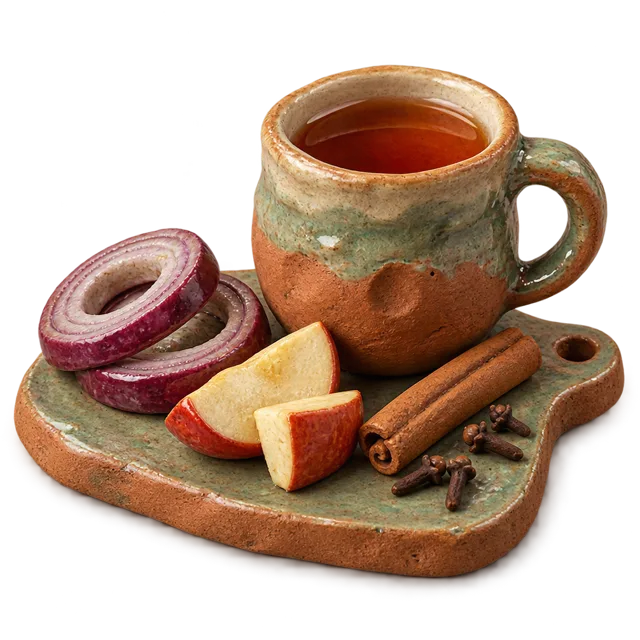
Onion, apple and spice tea
Traditionally drunk as a warming tea for a cold and the sore throat that comes with it. Cultural practice, not studied: this tea hasn't been tested for colds or sore throats. Its ingredients are everyday foods and spices; NCCIH says cinnamon is likely safe in food amounts, but that doesn't show the tea eases a cold. A warm drink does fit NHS self-care advice for colds (rest and plenty of fluids).
Where it comes from
This sweet-spiced onion tea is a familiar Dominican home remedy. Ethnobotanist Ina Vandebroek of the New York Botanical Garden learned the recipe while documenting how New York City's Dominican community uses plants, and notes that it is made only from food plants and spices sold in ordinary supermarkets. In the Dominican countryside, a morning cup of tea made from local plants has long been valued for warming up the body.
You'll need
- onion, red or white, cut into thick rings1
- apple, cut into pieces1
- lime, peeled and cut into pieces½
- cinnamon stick1
- whole cloves3
- allspice berries, lightly crushed3
- fresh ginger, peeled and sliced2 cm piece
- water375 ml (1½ cups)
- honey (optional)1 tsp
How it's made
- 1Adults only. Put everything except the honey into a small pan.
- 2Simmer gently over a low heat for about 20 minutes, until the kitchen smells sweet and the tea turns pale yellow (or reddish-brown with red onion).
- 3Strain out the solids and stir in a little honey if you like.
- 4Let it cool until comfortably warm before you sip it.
- 5Some cooks add star anise; we leave it out, because the US FDA has warned against teas brewed from star anise after illnesses linked to the toxic Japanese kind getting mixed in.
What the evidence says
Cultural practice, not studied: this tea hasn't been tested for colds or sore throats. Its ingredients are everyday foods and spices; NCCIH says cinnamon is likely safe in food amounts, but that doesn't show the tea eases a cold. A warm drink does fit NHS self-care advice for colds (rest and plenty of fluids).
A real tradition we can document, but nobody has properly tested it.
Who should skip it
- 🤰 Pregnant or breastfeeding? Check with your midwife or doctor first
- 🧒 For adults only (under 18s should skip it)
- 💊 In pregnancy and breastfeeding, don't drink spice brews like this repeatedly as a remedy without advice from your midwife, doctor or pharmacist: NCCIH says Ceylon cinnamon in larger amounts is considered unsafe in pregnancy, and little is known about larger amounts while breastfeeding
- 💊 Cassia cinnamon contains coumarin, which can affect the liver in sensitive people; if you have liver disease, don't drink it often (NCCIH)
- 💊 Ginger can cause heartburn or throat irritation in some people (NCCIH)
- 💊 Don't add star anise (US FDA advisory)
- 🌼 Onion (allium) intolerance
- 🌼 Apple or citrus allergy
- 🌼 Cinnamon or spice allergy
- 🌼 Bee products, if you add honey
- Cold symptoms that get worse, or don't improve after 10 days
- A sore throat that doesn't improve after a week
- A high temperature for more than 3 days, a very high temperature, or you feel hot, cold or shivery
- Get urgent advice (NHS 111 or your doctor) for a sore throat with a very high temperature, or if you have a weakened immune system
- Call 999 (UK) or 911 (US) now if you have difficulty breathing, can't swallow, are drooling, make a high-pitched sound when you breathe, or have sudden chest pain
Sources
- A Dominican tea for cold winter evenings (New York Botanical Garden (Science Talk))
- Center for Food Safety and Applied Nutrition 2003 (star anise tea advisory) (US FDA)
- Cinnamon: usefulness and safety (NCCIH)
- Ginger: usefulness and safety (NCCIH)
- Common cold (NHS)
- Sore throat (NHS)
By the Remedies by Culture editorial team · Last checked 2 October 2026 · Not medical advice, and not medically reviewed.