Homes across Jordan and the wider Levant, where a sprig of sage goes into the teapot after a meal · Tea · 10 min
Shai bil maramiya (شاي بالمرمية)
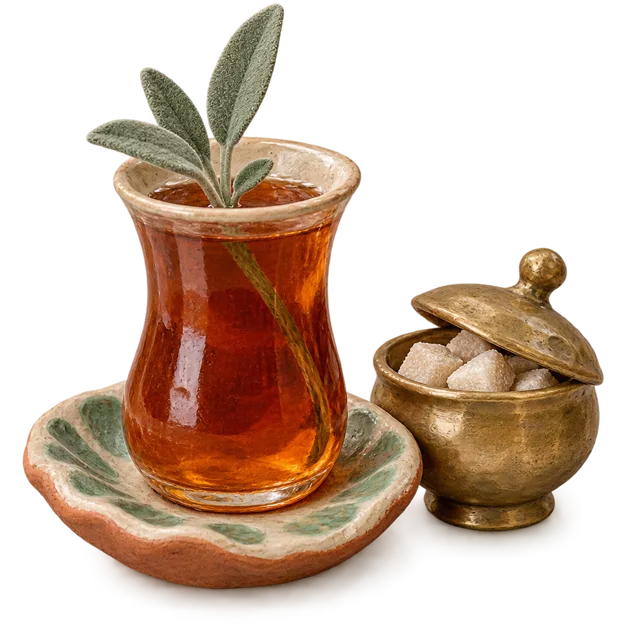
Black tea with sage
Traditionally drunk after meals, or when the stomach feels upset or heavy. Traditional use. The EMA recognises sage leaf tea as a traditional herbal medicine for mild indigestion such as heartburn and bloating, in adults, based on long use rather than trials (its dose is 1 to 2 g of leaf in 150 ml of water, up to 3 times a day, for no more than 2 weeks without advice, and licensed products must keep thujone below a set daily limit). There are no good trials of sage tea for indigestion, and this sweet black-tea version hasn't been studied. The wild maramiya sold in the Levant is often Greek sage (Salvia fruticosa), for which the EMA didn't adopt a monograph, so this recipe is our adaptation of the regional tea using labelled common sage.
Where it comes from
Maramiya, sage, grows wild on the hills of Jordan and Palestine and is sold in bunches in markets across the Levant. A few leaves slipped into a pot of sweet black tea is served after meals in many Jordanian and Palestinian households, and it's a familiar home choice when someone has a stomach ache.
You'll need
- common sage (Salvia officinalis) sold for making tea, from a labelled pack (tea bags or dried leaf)1 tea bag, or the amount the pack gives for one cup (no more than 1 g)
- black tea1 tea bag or 1 tsp loose
- just-boiled water250 ml
- sugar (optional)to taste
How it's made
- 1Brew the black tea in the just-boiled water for 3 minutes.
- 2Add the sage as the pack directs (amount and steeping time), then strain.
- 3Sweeten lightly if you like, let it cool until comfortably warm, and sip it slowly after a meal.
- 4Adults only. Use a labelled common sage product only, not wild or unidentified maramiya, which is often a different sage. Sage contains thujone, which can be harmful in large amounts or with long use, and the amount varies between products, so we don't suggest how often to drink it. Stop and see a doctor if stomach symptoms last more than 2 weeks.
What the evidence says
Traditional use. The EMA recognises sage leaf tea as a traditional herbal medicine for mild indigestion such as heartburn and bloating, in adults, based on long use rather than trials (its dose is 1 to 2 g of leaf in 150 ml of water, up to 3 times a day, for no more than 2 weeks without advice, and licensed products must keep thujone below a set daily limit). There are no good trials of sage tea for indigestion, and this sweet black-tea version hasn't been studied. The wild maramiya sold in the Levant is often Greek sage (Salvia fruticosa), for which the EMA didn't adopt a monograph, so this recipe is our adaptation of the regional tea using labelled common sage.
Has an EMA traditional-use monograph: long, documented use, but not proven in trials.
Who should skip it
- 🤰 Avoid in pregnancy
- 🧒 For adults only (under 18s should skip it)
- 💊 Not for children or teenagers under 18 (EMA)
- 💊 Don't use it in pregnancy or while breastfeeding: the EMA doesn't recommend it, and NCCIH says its thujone may be harmful in pregnancy
- 💊 Sage leaf contains thujone, which can be toxic in large amounts or with long use (NCCIH). The EMA knows of no overdose from sage leaf; the racing heart, dizziness and fits it describes came from sage oil equal to more than 15 g of leaf. Never take sage essential oil by mouth. As a precaution (our advice, not an EMA rule), don't use it as a remedy if you've ever had a seizure
- 💊 Black tea contains caffeine, which can make heartburn and sleep problems worse
- 🌼 Mint-family (Lamiaceae) allergy
- Call 999 (UK) or 911 (US), or go to A&E/the ER, now if tummy pain comes on very suddenly or is severe, it hurts to touch your tummy, you're vomiting blood or vomit that looks like ground coffee, your poo is bloody or black, sticky and very smelly, or you can't poo or fart
- Ask for an urgent GP appointment or call NHS 111 (in the US, see a doctor promptly) if a stomach ache gets much worse, keeps coming back, or comes with bloating that won't go away, trouble swallowing food, weight loss without trying, or bleeding from your bottom
- See a GP if indigestion or bloating keeps coming back, or you're often bloated
Sources
- Salviae officinalis folium (sage leaf) herbal monograph (EMA)
- Sage (NCCIH)
- Salviae trilobae folium (Greek sage): public statement (EMA)
- Arabic tea (Wikipedia)
- The Gaza Kitchen review and shay bil maramiya (Tara's Multicultural Table)
- Indigestion (NHS)
- Stomach ache (NHS)
- European Union herbal monograph on Salvia officinalis L., folium (Rev. 1) (EMA)
By the Remedies by Culture editorial team · Last checked 2 October 2026 · Not medical advice, and not medically reviewed.