
Jamaica, where small farms and producers make it by hand, and Black hair care worldwide, where it is a best-selling oil · On the skin · 5 min
Jamaican black castor oil (JBCO)
The belief that Jamaican black castor oil regrows hair and edges
Widely believed to regrow thinning hair and edges and to thicken eyebrows; traditionally used as a heavy oil for hair and skin. There's no good evidence that castor oil, black or clear, makes hair grow. A 2022 systematic review found no strong evidence for hair growth and only weaker evidence for shinier hair. Castor oil is a thick, heavy oil; rare reactions include allergic contact dermatitis and sudden matting of long hair. For thinning edges, the AAD's advice is to take the tension off the hairline and see a dermatologist early, because traction hair loss can become permanent.
Where it comes from
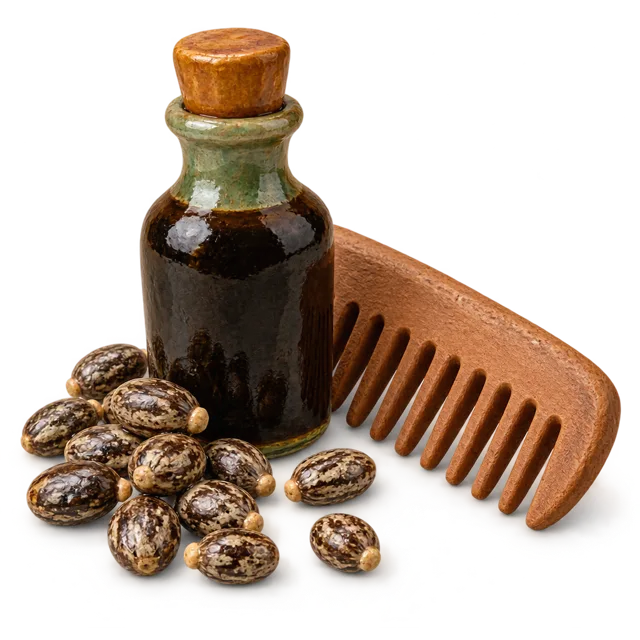
Jamaican black castor oil is made the traditional way by roasting castor beans, which gives the oil its dark colour and smoky smell, then crushing and boiling them. The Jamaica Castor Industry Association describes it as a prized part of the island's castor industry, made mainly by small farms and producers. It has become one of the best-known oils in Black hair care around the world.
You'll need
- Jamaican black castor oil, from a labelled cosmetic product, only if you like how it feelsa few drops
- a looser hairstyle around your hairlineas often as you can
How it's made
- 1What people do: rub Jamaican black castor oil into the scalp, thinning patches and the edges of the hairline every day, in the belief it will regrow hair.
- 2What the evidence suggests instead: a 2022 systematic review found no strong evidence that castor oil helps hair grow; at most there is weak evidence that it adds shine. A 2026 dermatology review found that the idea rests mainly on lab findings and anecdote.
- 3Thinning edges are very often traction alopecia, caused by tight braids, cornrows, ponytails, weaves and wigs. The American Academy of Dermatology advises loosening styles around the hairline, wearing braids for no longer than 6 to 8 weeks, and removing a weave straight away if it hurts.
- 4If you like it as a heavy moisturiser for the scalp or hair ends, patch test first as the AAD advises: dab a little on your inner arm twice a day for 7 to 10 days, and don't use it if you get redness, itching or swelling. A home patch test can't rule out an allergy; castor oil can cause allergic contact dermatitis.
- 5Castor oil is very thick. In a reported case, long hair matted into an irreversible 'bird's nest' (acute hair felting) the first time castor oil was used, and the hair had to be cut off. No amount is known to prevent this, so if your hair is long, think twice, and stop if it starts to tangle.
- 6Keep it out of your eyes, and never swallow castor oil: large amounts can be poisonous (MedlinePlus).
What the evidence says
There's no good evidence that castor oil, black or clear, makes hair grow. A 2022 systematic review found no strong evidence for hair growth and only weaker evidence for shinier hair. Castor oil is a thick, heavy oil; rare reactions include allergic contact dermatitis and sudden matting of long hair. For thinning edges, the AAD's advice is to take the tension off the hairline and see a dermatologist early, because traction hair loss can become permanent.
Popular, but studies show it doesn't do what people think.
Who should skip it
- 🤰 Pregnant or breastfeeding? Check with your midwife or doctor first
- 🧒 Not for children under 12
- 💊 Never swallow castor oil or give it to anyone to swallow: large amounts can be poisonous
- 💊 Its safety on the skin in pregnancy and breastfeeding hasn't been studied
- 💊 Castor oil has caused sudden, irreversible matting of long hair in a case report; no amount is known to be safe, so stop if hair starts to tangle
- 🌼 Castor oil (ricinoleic acid) can cause allergic contact dermatitis; if you've reacted to castor oil or lipsticks and cosmetics containing it, don't use it
- 🌼 A home patch test can't rule out an allergy
- Broken hairs around your forehead, a receding hairline or patches of hair loss where hair is pulled tight: see a dermatologist early, as traction hair loss can become permanent
- Patchy hair loss, or a sore, scaly, crusted or stinging scalp
- Hair that suddenly mats into a hard tangle that won't comb out
- A rash that spreads, blisters or keeps itching after you stop using it
- Call 999 (UK) or 911 (US) now if your lips, tongue or throat swell or you have trouble breathing
Sources
- Coconut, castor, and argan oil for hair in skin of color patients: a systematic review (J Drugs Dermatol, 2022) (PubMed)
- Use of castor oil in dermatology: a narrative review (Cureus, 2026) (PubMed Central)
- 'Castor oil': the culprit of acute hair felting (Int J Trichology, 2017) (PubMed Central)
- Hairstyles that pull can lead to hair loss (American Academy of Dermatology)
- How to test skin care products (American Academy of Dermatology)
- Castor oil overdose (MedlinePlus)
- Frequently asked questions (Jamaica Castor Industry Association)
By the Remedies by Culture editorial team · Last checked 2 October 2026 · Not medical advice, and not medically reviewed.