
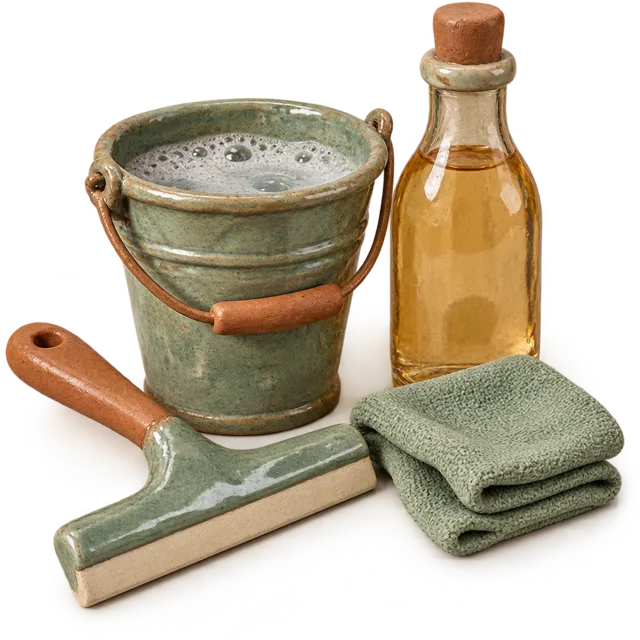
Dutch homes, where washing the windows ('ramen lappen') is a familiar household chore · Home hack · 30 min
Ramen lappen met azijn
Vinegar water for cleaning windows
Traditionally used to wash windows to a streak-free shine and cut the greasy film that builds up on the glass. A household habit, not tested in studies. Vinegar is a mild acid that helps cut greasy film and limescale on glass; it cleans but doesn't disinfect. The real risks are mixing it with bleach, which releases chlorine gas, and splashing it in your eyes: US Poison Control describes a man who splashed vinegar in his eye and was left with small scratches on the cornea.
Where it comes from
Washing the windows, 'ramen lappen', is a regular chore in many Dutch households, and a splash of vinegar in a bucket of warm water is one of the classic tips, still passed on by the Dutch broadcaster MAX. Schoonmaakazijn, Dutch cleaning vinegar, contains roughly 7 to 15% acetic acid, two to three times as much as table vinegar, and isn't meant for food.
You'll need
- white table vinegar (not cleaning vinegar)about 100 ml (our reading of 'a splash')
- lukewarm water1 bucket (about 5 litres)
- sponge or window washer, a squeegee, and a microfibre cloth or crumpled newspaper1 each
- rubber gloves1 pair
How it's made
- 1Put on rubber gloves. Add about 100 ml of white table vinegar to a bucket of lukewarm water; that amount is our own suggestion, as MAX doesn't give one. If you use schoonmaakazijn (cleaning vinegar) instead, dilute it exactly as its label says. Use vinegar and water only: never add bleach or any other cleaning product.
- 2Pick a dry, cloudy day if you can: in bright sun the glass dries too fast and streaks. On a very cold day use lukewarm, not warm, water.
- 3Wash the glass with the sponge or window washer, then pull the water off with a squeegee from top to bottom, wiping the blade after each stroke.
- 4Buff the edges and any drips with a dry microfibre cloth or crumpled newspaper.
- 5Wipe any drips off natural-stone sills (marble, limestone, bluestone) and metal fittings straight away, and rinse them with plain water.
- 6Clean upstairs windows from inside with a long-handled squeegee; don't lean out or stand on chairs or window sills.
- 7Pour the leftover water away and store the vinegar bottle closed, labelled and out of reach of children, away from food.
What the evidence says
A household habit, not tested in studies. Vinegar is a mild acid that helps cut greasy film and limescale on glass; it cleans but doesn't disinfect. The real risks are mixing it with bleach, which releases chlorine gas, and splashing it in your eyes: US Poison Control describes a man who splashed vinegar in his eye and was left with small scratches on the cornea.
A real tradition we can document, but nobody has properly tested it.
Who should skip it
- 🤰 Fine in normal food amounts in pregnancy
- 🧒 For adults only (under 18s should skip it)
- 💊 Never mix vinegar with bleach: it releases chlorine gas, which irritates the airways, eyes, nose and throat
- 💊 Never mix bleach with ammonia (found in some window cleaners), and don't mix cleaning products at all
- ⚠️ Never mix vinegar with bleach (chlorine gas), never mix bleach with ammonia, and don't mix cleaning products
- ⚠️ Cleaning vinegar (schoonmaakazijn) is two to three times stronger than table vinegar and isn't for food: wear gloves and keep it labelled and away from food and children
- ⚠️ Acid can etch natural stone such as marble and limestone: keep it off stone sills and worktops, and wipe drips straight away
- ⚠️ Don't lean out of upstairs windows or stand on chairs; use a long-handled squeegee or a proper step ladder
- ⚠️ It cleans but doesn't disinfect
- Vinegar in the eye: take out contact lenses and rinse with lots of room-temperature water for at least 15 to 20 minutes, then call US Poison Control (1-800-222-1222) or NHS 111 (UK) for advice
- Go to A&E or call 999 (UK) / 911 (US) if a strong chemical such as bleach gets in your eye (keep rinsing while you wait), or after an eye splash you have severe pain, changes in your sight, or can't keep the eye open
- If you cough, feel short of breath or your eyes burn after cleaning products were mixed: get into fresh air and call Poison Control or NHS 111; call 999 or 911 if breathing is difficult
Sources
- Ramen lappen zonder strepen, zo lukt het (MAX Vandaag (Omroep MAX, Netherlands))
- Schoonmaakazijn (Wikipedia (Dutch))
- No, vinegar is not always safe (Poison Control (US))
- Dangers of mixing bleach with cleaners (Washington State Department of Health)
- First aid for poisonings (Poison Control (US))
- Eye injuries (NHS)
By the Remedies by Culture editorial team · Last checked 2 October 2026 · Not medical advice, and not medically reviewed.


