Across Vietnam, where grandmothers and mothers boiled the dried pods to wash their hair long before bottled shampoo · On the skin · 30 min
Nước bồ kết
Honey-locust pod hair wash
Traditionally used as an everyday hair wash, leaving hair clean and softly scented; it isn't a hair-growth or anti-dandruff remedy. Cultural practice, not studied. We found no clinical trials of bồ kết as a hair wash. A lab study of the related Chinese species, Gleditsia sinensis, found saponins (natural soap-like compounds) at higher levels in its fruit than in other parts of the plant; that's indirect evidence for why the liquid lathers a little, and it says nothing about safety on the scalp. Popular claims that it stops hair loss, makes hair grow or clears dandruff haven't been shown. For dandruff, the AAD recommends a dandruff shampoo with an active ingredient such as zinc pyrithione, salicylic acid, selenium sulfide or ketoconazole.
Where it comes from
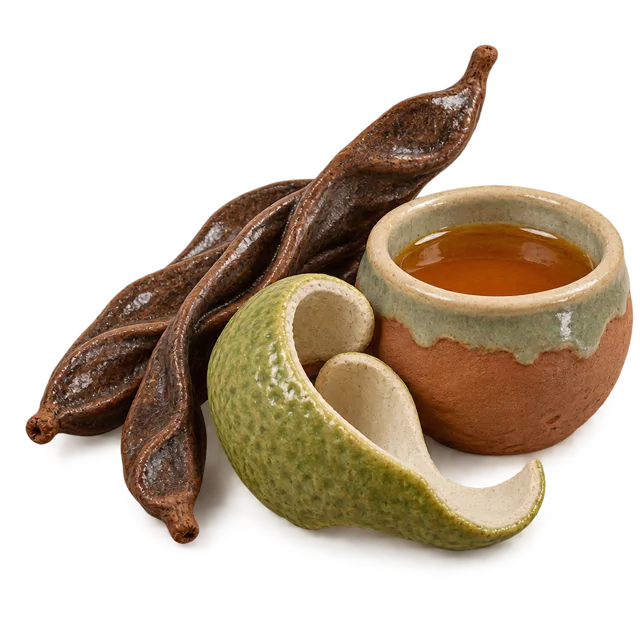
Bồ kết is the dried, dark-brown seed pod of a Gleditsia tree (in Vietnam usually Gleditsia australis), a relative of the honey locust. Boiled with pomelo peel, it was once the hair wash used by most Vietnamese women, according to VnExpress, and older women in some villages still sell the pods all year round. Today small Vietnamese brands bottle bồ kết shampoo, often mixed with lemongrass, lemon, ginger or pomelo peel.
You'll need
- dried bồ kết pods sold for washing hair, from a pack whose label gives the botanical species (Gleditsia); don't use pods you can't identify3 to 4 pods
- dried or fresh pomelo peel (optional, for scent)a small handful
- a stalk of lemongrass, bruised (optional)1
- water1.5 litres
How it's made
- 1Patch test first, the way you'll use it: the American Academy of Dermatology suggests testing a wash-off product twice a day for 7 to 10 days on a small spot such as the inside of your arm, leaving it on for about 5 minutes before rinsing. Make a small batch each time you test. Don't use it if you get redness, itching or swelling. A home patch test can't rule out an allergy.
- 2Rinse the pods and break them into short pieces. (Many families toast them in a dry pan first for a warmer smell; we leave that step out.)
- 3Put the pods, pomelo peel and lemongrass in a pan with the water, bring to the boil and simmer gently for 15 to 20 minutes.
- 4Take it off the heat and leave it to cool until it's only lukewarm. Test the temperature on your wrist before it goes anywhere near your scalp. Strain out the solids.
- 5Dilute it with the same amount of plain lukewarm water if your scalp is sensitive.
- 6Lean forward, close your eyes, and pour it slowly over wet hair. Massage your scalp gently with your fingertips for a minute or two. It makes only a little lather.
- 7Rinse thoroughly with plain water. If it gets in your eyes, rinse them with plenty of clean, lukewarm water; like shampoo, it stings.
- 8Make a fresh batch on the day you use it and pour away any left over. It's a wash, not a drink: keep it labelled and away from children.
What the evidence says
Cultural practice, not studied. We found no clinical trials of bồ kết as a hair wash. A lab study of the related Chinese species, Gleditsia sinensis, found saponins (natural soap-like compounds) at higher levels in its fruit than in other parts of the plant; that's indirect evidence for why the liquid lathers a little, and it says nothing about safety on the scalp. Popular claims that it stops hair loss, makes hair grow or clears dandruff haven't been shown. For dandruff, the AAD recommends a dandruff shampoo with an active ingredient such as zinc pyrithione, salicylic acid, selenium sulfide or ketoconazole.
A real tradition we can document, but nobody has properly tested it.
Who should skip it
- 🤰 Pregnant or breastfeeding? Check with your midwife or doctor first
- 🧒 Not for children under 12
- 💊 Its safety on the scalp in pregnancy and breastfeeding hasn't been studied
- 💊 It stings if it gets in the eyes: keep your eyes closed while rinsing, and if it gets in, wash them with plenty of clean water (NHS)
- 💊 Never drink it or give it to anyone to drink; it's for washing hair only
- 🌼 Don't use it if you've reacted to bồ kết shampoos before, or to citrus peel or lemongrass if you add them
- 🌼 A home patch test can't rule out an allergy
- Patchy hair loss, hair loss after using a new product, or a sore, scaly or crusted scalp
- Dandruff that doesn't get better with a dandruff shampoo, or a very itchy, red scalp
- Get urgent advice (NHS 111 or your doctor) if your eye isn't getting better 24 hours after rinsing it; go to A&E or call 999 (UK) or 911 (US) if you have severe eye pain or any change in your sight
- A rash that spreads, blisters or keeps itching after you stop using it
- Call 999 (UK) or 911 (US) now if your lips, tongue or throat swell or you have trouble breathing
Sources
- Khởi nghiệp với trái bồ kết (Starting a business with bồ kết pods) (VnExpress)
- Chi Bồ kết (Gleditsia) (Wikipedia (Vietnamese))
- Identification of potential genes involved in triterpenoid saponins biosynthesis in Gleditsia sinensis by transcriptome and metabolome analyses (J Nat Med, 2019) (PubMed)
- How to treat dandruff (American Academy of Dermatology)
- Tips for healthy hair (American Academy of Dermatology)
- Eye injuries (NHS)
- How to test skin care products (American Academy of Dermatology)
By the Remedies by Culture editorial team · Last checked 2 October 2026 · Not medical advice, and not medically reviewed.