Kitchens across India, where brass and copper pots, lamps and water vessels are still in use in many households · Home hack · 20 min
Imli se pital ki safai (इमली से पीतल की सफ़ाई)
Tamarind (or lemon and salt) polish for brass and copper
Traditionally used to bring back the shine on tarnished brass and copper pots, lamps and water vessels. A household habit, not tested in studies. Tamarind and lemon are acidic and salt is a mild abrasive, which is why they lift tarnish; it's a polish, not a disinfectant, and the item still needs a proper wash. What matters most for safety is the pot, not the polish: the FDA warns against cooking in unlined copper, because copper can leach into acidic food.
Where it comes from
In many Indian homes, brass and copper vessels are polished the old way, with a rub of tamarind pulp and salt, or a salted half lemon, rather than a shop-bought polish. Copper and brass cookware was also traditionally lined with tin by craftsmen called kalaiwalas or kalaigars, a craft known as kalai that is now becoming rare.
You'll need
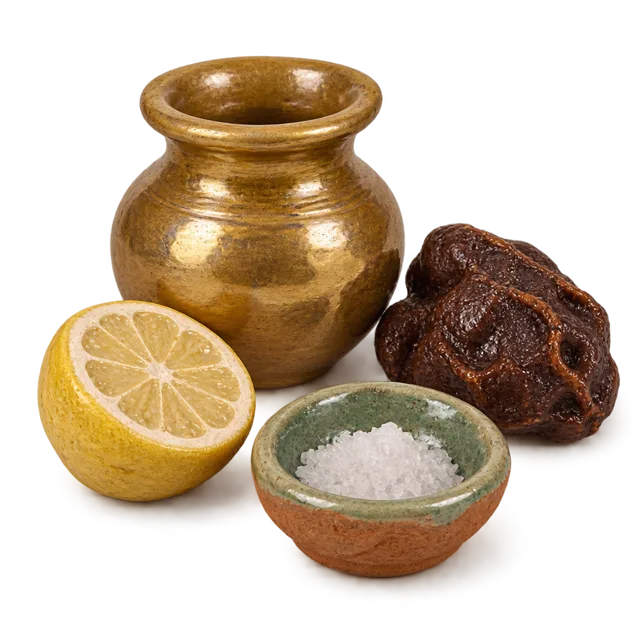
- a lump of tamarind (imli) pulp, or the squeezed-out pulp left after cookingabout the size of a walnut
- warm watera few tablespoons
- salt1 tsp
- or: half a lemon dipped in salt1
- soft cloth and mild washing-up liquid1
How it's made
- 1Check the item first: this is for bare (unlacquered) solid brass or copper. Don't use it on lacquered, plated, painted or antique pieces, and try it on a hidden spot first, because salt is mildly scratchy.
- 2Soak the tamarind in a little warm water for 10 minutes, then mash it into a thick pulp and mix in the salt. Or simply dip the cut side of half a lemon in salt.
- 3Rub the pulp (or the salted lemon) over the tarnished metal with a soft cloth, in small circles. Leave it for a few minutes on stubborn spots.
- 4Rinse very well, wash with warm water and a little washing-up liquid to remove every trace of acid, and dry straight away with a soft cloth. Acid left on the metal can spot or re-tarnish it.
- 5Throw away the used tamarind or lemon straight away: don't eat it or cook with it, and keep it away from children and dogs (see warnings).
- 6Older copper and brass cookware may have tin or nickel linings that shouldn't be used for cooking (MedlinePlus). If a pot's lining is worn, or you don't know how old it is, don't cook in it: ask a professional re-tinner (kalaigar) whether it can be made fit for food, and otherwise keep it for display.
What the evidence says
A household habit, not tested in studies. Tamarind and lemon are acidic and salt is a mild abrasive, which is why they lift tarnish; it's a polish, not a disinfectant, and the item still needs a proper wash. What matters most for safety is the pot, not the polish: the FDA warns against cooking in unlined copper, because copper can leach into acidic food.
A real tradition we can document, but nobody has properly tested it.
Who should skip it
- 🤰 Fine in normal food amounts in pregnancy
- 🧒 For adults only (under 18s should skip it)
- 💊 Don't cook in unlined copper, or in a copper or brass pot whose tin lining is worn: the FDA warns copper can leach into acidic food
- 💊 Don't mix it with other cleaning products
- 🌼 Lemon juice and salt sting cuts and cracked skin: wear gloves if your hands are sore
- ⚠️ Only for bare, solid brass or copper: it strips lacquer and can damage plated, painted or antique pieces; test a hidden spot first
- ⚠️ Rinse off every trace of acid and dry straight away, or the metal can spot and tarnish again
- ⚠️ It polishes; it doesn't disinfect. Wash cooking pots with hot soapy water afterwards
- ⚠️ Tamarind is dangerous for dogs: in ASPCA poison-centre reports, dogs that ate tamarind developed kidney injury. Keep the pulp and the bin out of their reach
- ⚠️ Don't cook in a pot whose tin (kalai) lining is worn or old: have a professional check whether it can be made fit for food first
- ⚠️ Don't eat used polishing pulp or lemon, and keep it away from children
- ⚠️ Never mix cleaning products, and never mix bleach with vinegar or ammonia
- Lemon or tamarind juice in the eye: take out contact lenses and rinse with lots of room-temperature water for 15 to 20 minutes, then call US Poison Control (1-800-222-1222) or NHS 111 (UK) for advice. If pain, redness, blurred sight or watering still last an hour after you started rinsing, get an urgent eye check; if it's severe, or your sight changes, go to A&E or call 999 (UK) / 911 (US) straight after rinsing (Poison Control)
- If a dog eats tamarind, call your vet or an animal poison line straight away, even if it seems well
Sources
- How to Clean Old Copper & Brass Utensils at Home Easily (Pitambari (India))
- Tamarind: metal polish (Wikipedia)
- Kalai (process) (Wikipedia)
- Cooking utensils and nutrition (MedlinePlus (US National Library of Medicine))
- Acute kidney injury in dogs following ingestion of cream of tartar and tamarinds (J Vet Emerg Crit Care, 2022; ASPCA Animal Poison Control Center) (PubMed)
- First aid for poisonings (Poison Control (US))
By the Remedies by Culture editorial team · Last checked 2 October 2026 · Not medical advice, and not medically reviewed.