Central Java, where it began in the royal courts, and now homes and spas all over Indonesia · On the skin · 20 min
Lulur
Javanese rice-flour and turmeric body scrub
Traditionally used as a gentle exfoliating scrub to leave skin feeling smooth, soft and pleasantly scented. Cultural practice, not studied. Rice flour works as a mild physical scrub, but we found no trials of lulur itself. In Indonesia lulur is often sold as making skin 'brighter' or lighter in tone. Skin lightening is not a benefit we claim, it hasn't been shown for lulur, and the yellow tint from turmeric is a stain that washes off. NCCIH notes that curcumin, turmeric's main compound, can cause hives or itching on the skin, and a dermatology review describes turmeric as a recognised cause of allergic skin reactions. The AAD warns that over-exfoliating can leave skin red and irritated, and that harsh scrubbing can cause dark spots, especially on darker skin.
Where it comes from
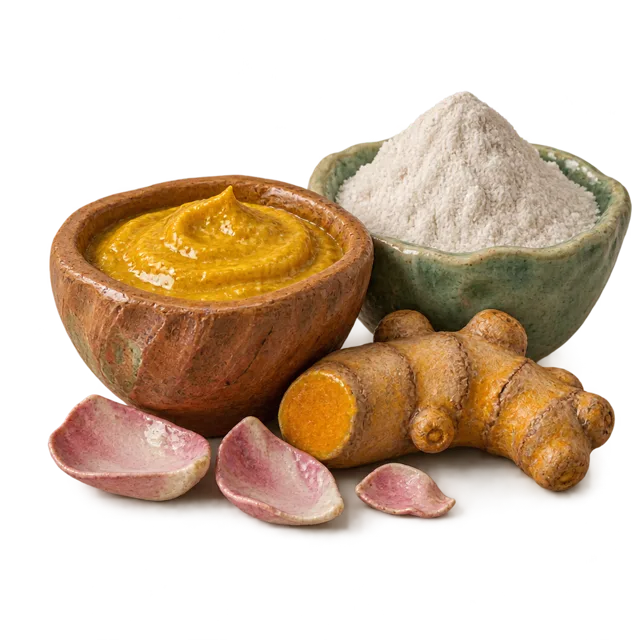
Lulur (luluran) is Java's best-known beauty scrub. Kompas reports that written records of it begin in the 17th-century royal courts (keraton) of Central Java, where princesses used it every two weeks, and that it later spread beyond the palace walls to ordinary households. The classic Javanese yellow lulur is made from rice flour, turmeric, pandan and temu giring, mixed with rose water.
You'll need
- rice flour2 tbsp
- ground turmeric¼ tsp
- water or plain rose waterabout 1½ tbsp, enough for a thick paste
How it's made
- 1Patch test first, the way you'll use it, as the American Academy of Dermatology advises: put the normal amount of paste on a small spot such as the inside of your arm, leave it until it dries as you would on your body, rub it off gently and rinse; do this twice a day for 7 to 10 days. Don't use it if you get redness, itching or swelling. A home patch test can't rule out an allergy, and a test with no reaction doesn't show your skin will cope with scrubbing larger areas; if you're allergic to turmeric or rice, don't use it.
- 2In a clean bowl with a clean spoon, mix the rice flour and turmeric with just enough water or rose water to make a thick paste. Make a fresh portion each time and throw away any leftover.
- 3Wear old clothes and use an old towel: turmeric stains skin, nails, fabric and grout yellow. The tint on skin is temporary and fades with washing.
- 4Spread a thin layer on damp skin on your arms, legs and body. This is a body scrub: keep it off your face, away from your eyes, and off broken, sunburnt, irritated or freshly shaved skin.
- 5Let it dry for a few minutes, then rub it off very gently with your fingertips in small circles, about 30 seconds per area, as the AAD advises for scrubs. Don't scrub hard, and stop if your skin turns red or sore.
- 6Rinse with lukewarm, not hot, water, pat dry and moisturise straight away.
- 7Once a week is plenty. If your skin turns red or irritated, use it less often or stop.
What the evidence says
Cultural practice, not studied. Rice flour works as a mild physical scrub, but we found no trials of lulur itself. In Indonesia lulur is often sold as making skin 'brighter' or lighter in tone. Skin lightening is not a benefit we claim, it hasn't been shown for lulur, and the yellow tint from turmeric is a stain that washes off. NCCIH notes that curcumin, turmeric's main compound, can cause hives or itching on the skin, and a dermatology review describes turmeric as a recognised cause of allergic skin reactions. The AAD warns that over-exfoliating can leave skin red and irritated, and that harsh scrubbing can cause dark spots, especially on darker skin.
A real tradition we can document, but nobody has properly tested it.
Who should skip it
- 🤰 Pregnant or breastfeeding? Check with your midwife or doctor first
- 🧒 Not for children under 12
- 💊 Its safety on the skin in pregnancy and breastfeeding hasn't been studied
- 💊 If you use retinoid creams, retinol or benzoyl peroxide, scrubbing can make skin drier and more irritated (AAD): skip it or ask your dermatologist
- 💊 Never use it on open cuts or sunburnt skin
- 💊 Turmeric stains skin, nails, clothes and towels yellow; the skin tint fades with washing
- 🌼 Turmeric (curcumin) on the skin can cause hives, itching or an allergic rash
- 🌼 Don't use it if you're allergic to rice, or to rose water if you use it
- 🌼 A home patch test can't rule out an allergy
- A rash that spreads, blisters or keeps itching after you stop using it
- Signs of infection: skin that's hot, swollen, painful or oozing
- Dark patches that appear after scrubbing and don't fade
- Call 999 (UK) or 911 (US) now if your lips, tongue or throat swell or you have trouble breathing
Sources
- Cerita lulur, dari putri raja ke rakyat jelata (The story of lulur, from royal princesses to ordinary people) (Kompas)
- Lulur tradisional untuk memanjakan kulit (Traditional lulur to pamper the skin) (Kompas)
- How to safely exfoliate at home (American Academy of Dermatology)
- Turmeric: usefulness and safety (NCCIH)
- Turmeric: the yellow allergen (Indian Dermatol Online J, 2023) (PubMed)
- How to test skin care products (American Academy of Dermatology)
By the Remedies by Culture editorial team · Last checked 2 October 2026 · Not medical advice, and not medically reviewed.