All over Myanmar, where it is worn on the cheeks every day by women, children and many men · On the skin · 5 min
Thanaka (သနပ်ခါး)
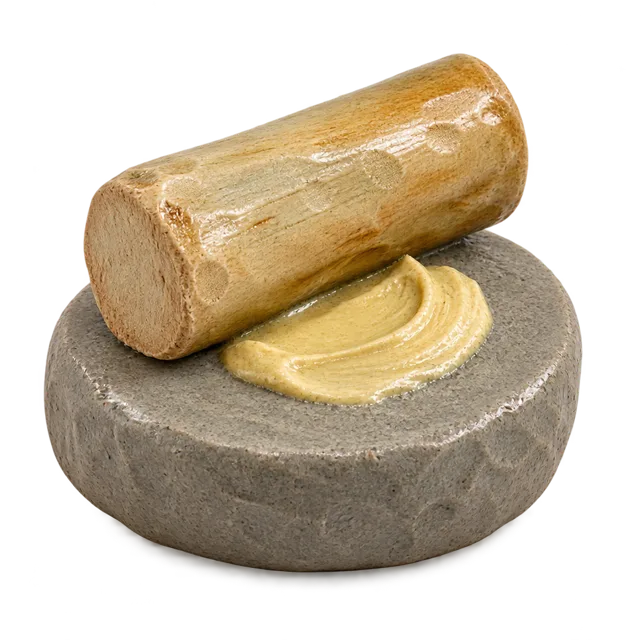
Thanaka bark paste
Traditionally worn as a cooling cosmetic paste to keep skin fresh and shaded in hot weather. Cultural practice, not studied in adequate human trials. A lab study of thanaka bark found low toxicity and some anti-inflammatory and antioxidant activity in the test tube, but that doesn't show it is safe or useful on people's skin. It is a cultural cosmetic and shouldn't replace sunscreen.
Where it comes from
Thanaka is a paste made from the ground bark of several trees, including Hesperethusa crenulata and the wood apple (Limonia acidissima). It is said to have been worn in Burma for over 2,000 years. The pale yellow paste is painted on in circles, stripes or leaf patterns and is one of the most recognisable sights in Myanmar.
You'll need
- a thanaka log or thanaka powder1 piece or ½ tsp
- watera few drops
How it's made
- 1Patch test first, as the American Academy of Dermatology advises for new skin products: dab a little on your inner arm twice a day for 7 to 10 days, and don't use it if you get redness, itching or swelling. This is general cosmetic advice; thanaka itself hasn't been safety-tested.
- 2Use clean equipment: grind the thanaka log on a clean, wet stone slab (a kyauk pyin) with a few drops of clean water, or mix a little powder with clean water to make a smooth paste.
- 3Make a fresh portion each time and throw away any leftover paste.
- 4Smooth it onto your cheeks and forehead in a thin layer and let it dry to a pale film. Keep it away from your eyes and off broken or irritated skin.
- 5Wash it off with water at the end of the day.
- 6It isn't a sunscreen: still use a proper broad-spectrum sunscreen (SPF 30 or more) in strong sun.
What the evidence says
Cultural practice, not studied in adequate human trials. A lab study of thanaka bark found low toxicity and some anti-inflammatory and antioxidant activity in the test tube, but that doesn't show it is safe or useful on people's skin. It is a cultural cosmetic and shouldn't replace sunscreen.
A real tradition we can document, but nobody has properly tested it.
Who should skip it
- 🤰 Pregnant or breastfeeding? Check with your midwife or doctor first
- 🧒 Not for children under 12
- 💊 Not a substitute for sunscreen
- 💊 Its safety in pregnancy and breastfeeding hasn't been studied in people
- 🌼 Don't use it if you're allergic to wood apple or citrus-family plants
- 🌼 A home patch test can't rule out an allergy; if you have a known plant allergy, ask a doctor or pharmacist first
- A rash that spreads, blisters or keeps itching after you stop using it
- Signs of infection: skin that's hot, swollen, painful or oozing
- A mole or dark patch that is new, changing shape or colour, bleeding or itchy
- Sunburn with blisters or swelling, or over a large area
Sources
- Thanaka: traditional Burmese sun protection (J Drugs Dermatol, 2014) (PubMed)
- Biological activities and safety of Thanaka (Hesperethusa crenulata) stem bark (J Ethnopharmacol, 2010) (PubMed)
- Thanaka (Wikipedia)
- Sunscreen and sun safety (NHS)
- How to test skin care products (American Academy of Dermatology)
By the Remedies by Culture editorial team · Last checked 2 October 2026 · Not medical advice, and not medically reviewed.