
Across China and the Chinese diaspora, where a gentle facial version of the old scraping practice is now a popular skin-care routine · Ritual · 10 min
Miànbù guāshā (面部刮痧)
Facial gua sha stone massage
A gentle facial version of gua sha is used as a calming skin-care massage; popular claims that it de-puffs, 'sculpts' or drains the face aren't supported by good evidence. Cultural practice, not well studied. The best evidence for the facial version is one small 2025 trial: 34 women used either a facial roller or a gua sha edge for 10 minutes, five times a week for 8 weeks, and measurements of face shape changed by about 2 mm. There was no group that did nothing, the tool was a plastic-and-steel device, and long-term effects weren't checked, so it doesn't show that gua sha lifts, slims or 'sculpts' the face. Claims about lymphatic drainage and younger-looking skin haven't been shown. A pilot study of traditional body gua sha in 11 people found it briefly increased blood flow in the scraped skin, and it deliberately raised petechiae and bruising.
Where it comes from
Gua sha means 'scraping sha': in traditional Chinese practice a smooth tool such as a ceramic spoon, coin or jade stone is scraped firmly over oiled skin on the back or limbs until red, bruise-like marks (sha) appear, a technique written about since the Ming dynasty. The light facial version, using flat jade or quartz stones, is a much gentler modern beauty adaptation. It took off worldwide on social media around 2021 and 2022.
You'll need
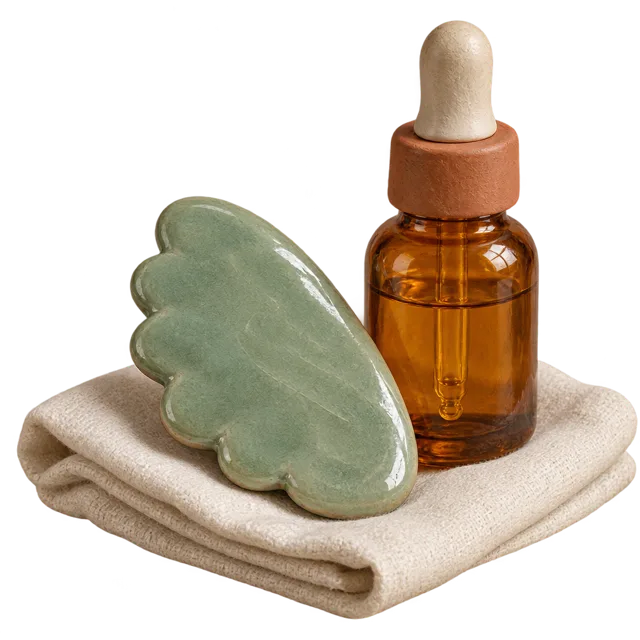
- a smooth, flat gua sha stone (jade, rose quartz or similar) with no chips or cracks1
- a plain facial oil or your usual moisturisera few drops
How it's made
- 1This is the gentle facial routine only. The traditional body gua sha, which is scraped firmly until red-purple marks appear, is a different practice and isn't covered here.
- 2Patch test the oil or moisturiser first, as the American Academy of Dermatology advises for new skin products: dab it on your inner arm twice a day for 7 to 10 days, and don't use it if you get redness, itching or swelling. A home patch test can't rule out an allergy.
- 3Our own hygiene precaution: wash the stone with mild soap and warm water and dry it, and start with a clean face and clean hands.
- 4Smooth a few drops of oil over your face and neck so the stone glides rather than drags.
- 5Hold the stone almost flat against your skin and stroke slowly outwards and upwards, from the chin along the jaw to the ear, and from the side of the nose across the cheek to the temple. Use 3 to 5 light strokes per area. Keep well away from your eyes.
- 6Pressure should be light: comfortable, with no pain. If your skin turns more than slightly pink, or you see any red dots or bruising, you're pressing too hard; stop.
- 7Wipe off excess oil. As our own precaution, wash the stone again, let it dry before storing it, and don't share it.
- 8Skip it on broken, sunburnt, infected or irritated skin, on active spots and during a rosacea flare (AAD). As our own precaution, also skip any area that's had fillers, injections or another facial procedure unless the clinic that did it says it's fine.
What the evidence says
Cultural practice, not well studied. The best evidence for the facial version is one small 2025 trial: 34 women used either a facial roller or a gua sha edge for 10 minutes, five times a week for 8 weeks, and measurements of face shape changed by about 2 mm. There was no group that did nothing, the tool was a plastic-and-steel device, and long-term effects weren't checked, so it doesn't show that gua sha lifts, slims or 'sculpts' the face. Claims about lymphatic drainage and younger-looking skin haven't been shown. A pilot study of traditional body gua sha in 11 people found it briefly increased blood flow in the scraped skin, and it deliberately raised petechiae and bruising.
A real tradition we can document, but nobody has properly tested it.
Who should skip it
- 🤰 Pregnant or breastfeeding? Check with your midwife or doctor first
- 🧒 For adults only (under 18s should skip it)
- 💊 Blood thinners such as warfarin or heparin, antiplatelet medicines such as clopidogrel, aspirin and steroid medicines can all make bleeding into the skin and bruising more likely (MedlinePlus). If you take any of them or have a bleeding disorder or low platelets, don't use gua sha unless your doctor says it's OK; light pressure doesn't make it safe
- 💊 Avoid it during a rosacea flare: the AAD advises against rubbing, scrubbing or massaging skin with rosacea
- 💊 Don't use it over active acne: the AAD warns that rubbing and touching spots can make acne worse
- 💊 Its use in pregnancy and breastfeeding hasn't been studied (the 2025 trial excluded pregnant and breastfeeding women); keep the pressure light and stop if anything feels uncomfortable
- 💊 Our own precaution: ask the clinic first if you've had fillers, injections or another facial procedure
- 🌼 Reactions are more likely to come from the oil or cream than the stone: don't use an oil you're allergic to (for example a tree-nut oil if you have a tree-nut allergy)
- 🌼 A home patch test can't rule out an allergy
- Bruising or red-purple dots that appear easily or for no clear reason, or bruising that doesn't fade
- A rash that spreads, blisters or keeps itching after you stop using the oil
- Signs of infection: skin that's hot, swollen, painful or oozing
- Rosacea or acne that's getting worse or getting you down
- Call 999 (UK) or 911 (US) now if your lips, tongue or throat swell or you have trouble breathing
Sources
- Comparative effects of facial roller and gua sha massage on facial contour, muscle tone, and skin elasticity: randomized controlled trial (J Cosmet Dermatol, 2025) (PubMed Central)
- The effect of Gua Sha treatment on the microcirculation of surface tissue: a pilot study in healthy subjects (Explore, 2007) (PubMed)
- Gua sha (Wikipedia)
- Bleeding into the skin (MedlinePlus)
- 7 rosacea skin care tips dermatologists recommend (American Academy of Dermatology)
- Acne: tips for managing (American Academy of Dermatology)
- How to test skin care products (American Academy of Dermatology)
By the Remedies by Culture editorial team · Last checked 2 October 2026 · Not medical advice, and not medically reviewed.


