
Japan, where it was the everyday face and body wash of Edo-period bathhouses before soap became common · On the skin · 10 min
Nukabukuro (糠袋)
Rice-bran wash bag
Traditionally used as a gentle everyday wash for the face and body, to leave skin feeling clean and soft. Cultural practice, not studied as a face or body wash. The closest study is old and small: 17 people with eczema were given a hospital-made rice bran broth to use in the bath. One stopped straight away because their skin got redder and itchier; most of the other 16 reported improvement over 2 to 5 months, but there was no comparison group. Claims that rice bran whitens, brightens or firms skin are not something we promote, and they haven't been shown for a bran bag. Rare case reports from Japan describe people, including a child whose family ran a rice shop, becoming allergic to rice after repeated skin contact with rice bran.
Where it comes from
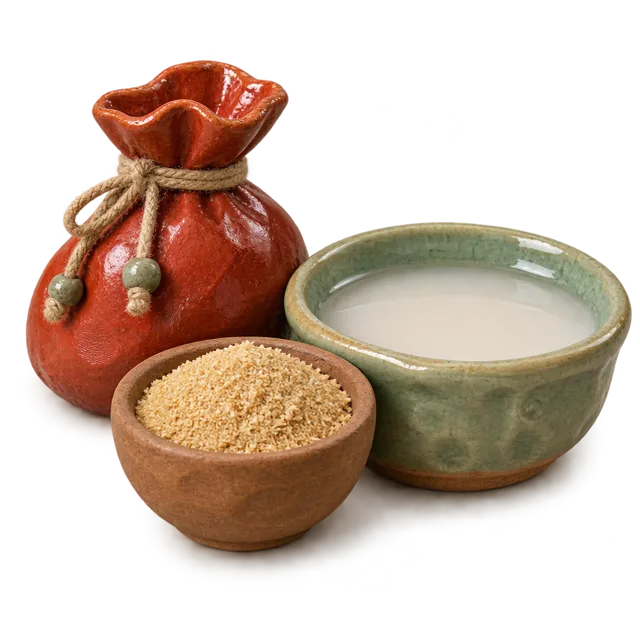
In Edo-period Japan (1603 to 1868), people used rice bran as face soap: they filled a small bag, often red, called a nukabukuro, soaked it in water and squeezed out the milky liquid to wash their face and body. Bran was sold at the public bathhouses, and people refilled their bags each visit. Writing in the late 1800s, the scholar Basil Hall Chamberlain called the bran bag Japan's 'original national cleanser'.
You'll need
- fresh food-grade rice bran (nuka)2 tbsp
- a small cotton or muslin bag, or a square of thin cotton tied with string1
- lukewarm watera bowlful
How it's made
- 1Patch test first, the way you'll use it: the American Academy of Dermatology suggests testing a wash-off product twice a day for 7 to 10 days on a small spot such as the inside of your arm, leaving it on for about 5 minutes before rinsing. Don't use it if you get redness, itching or swelling. A home patch test can't rule out an allergy; if you're allergic to rice, don't use it.
- 2Use fresh bran that smells sweet and nutty. Rice bran deteriorates quickly once it's milled because its oils go rancid (Foods review, 2023), so buy small packs, store them as the pack says and throw away any bran that smells sour or musty.
- 3Spoon the bran into a clean, dry bag and tie it closed.
- 4Soak the bag in lukewarm water for a minute, then squeeze it gently until a milky liquid comes out.
- 5On your face, smooth the milky liquid over damp skin with your fingertips rather than rubbing with the bag: the American Academy of Dermatology notes that washcloths, sponges and scrubbing can irritate facial skin. On your body you can press and pat the bag lightly over damp skin. Keep it away from your eyes and off broken, sunburnt or irritated skin.
- 6Rinse well with lukewarm water and pat dry.
- 7Empty out the used bran and throw it away. Wash the bag and let it dry completely before using it again; never keep damp bran for another day.
What the evidence says
Cultural practice, not studied as a face or body wash. The closest study is old and small: 17 people with eczema were given a hospital-made rice bran broth to use in the bath. One stopped straight away because their skin got redder and itchier; most of the other 16 reported improvement over 2 to 5 months, but there was no comparison group. Claims that rice bran whitens, brightens or firms skin are not something we promote, and they haven't been shown for a bran bag. Rare case reports from Japan describe people, including a child whose family ran a rice shop, becoming allergic to rice after repeated skin contact with rice bran.
A real tradition we can document, but nobody has properly tested it.
Who should skip it
- 🤰 Pregnant or breastfeeding? Check with your midwife or doctor first
- 🧒 Not for children under 12
- 💊 Its safety on the skin in pregnancy and breastfeeding hasn't been studied
- 💊 Go gently: scrubbing, washcloths and sponges can irritate facial skin (AAD)
- 🌼 Rice allergy: don't use it. Rare case reports describe people, including a child, becoming allergic to rice after repeated skin contact with rice bran
- 🌼 A home patch test can't rule out an allergy
- A rash that spreads, blisters or keeps itching after you stop using it
- Signs of infection: skin that's hot, swollen, painful or oozing
- Itching, hives or swelling after eating rice or touching rice bran: ask your doctor about allergy testing
- Call 999 (UK) or 911 (US) now if your lips, tongue or throat swell or you have trouble breathing
Sources
- It is not garbage! (Our Edo Beauty: nukabukuro bag) (POLA Research Institute of Beauty & Culture)
- Things Japanese: Bathing (B. H. Chamberlain) (Wikisource)
- The effects of rice bran broth bathing in patients with atopic dermatitis (Acta Paediatr Jpn, 1992) (PubMed)
- Pediatric case with rice bran allergy induced by epicutaneous sensitization in a family rice shop (Allergol Int, 2019) (PubMed)
- Case of rice allergy induced by epicutaneous sensitization to rice bran due to handling rice bran pickles (J Dermatol, 2012) (PubMed)
- Face washing 101 (American Academy of Dermatology)
- How to test skin care products (American Academy of Dermatology)
- Stabilization of rice bran: a review (Foods, 2023) (PubMed)
By the Remedies by Culture editorial team · Last checked 2 October 2026 · Not medical advice, and not medically reviewed.


