
Home kitchens across North India, each family with its own recipe · Tea · 20 min
Kadha (काढ़ा)
Spiced kitchen decoction
Traditionally sipped hot when a cough or cold sets in, especially as the seasons change. Kadha hasn't been tested in good trials for coughs, colds or sore throats, and the survey that recorded how popular it is didn't measure whether it helped. It's a warm, spicy drink; very strong or frequent brews can upset the stomach.
Where it comes from
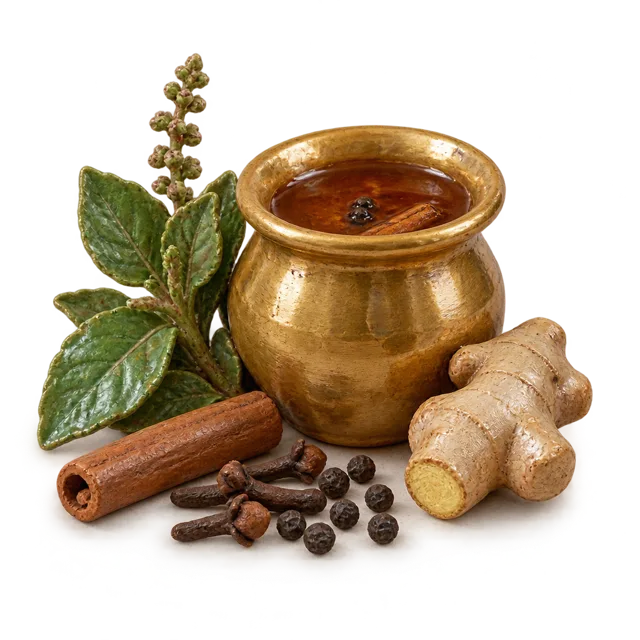
Kadha simply means a brew that has been boiled down, and every Indian kitchen has its own blend of tulsi, ginger, black pepper, cinnamon and cloves. It became even more common during the COVID-19 pandemic: in one survey of Indian COVID-19 patients, 59.6% of those who used home remedies or alternative medicine said they drank kadha.
You'll need
- water400 ml
- tulsi (holy basil) leaves6 to 8
- fresh ginger, sliced2 cm piece
- black peppercorns, crushed4
- cinnamon stick (Ceylon type)1 small piece
- cloves2
- jaggery or honey1 tsp
How it's made
- 1Put everything except the jaggery or honey into a pan with the water.
- 2Simmer for 10 to 15 minutes until the liquid has reduced by about half.
- 3Strain. Stir in jaggery while it's hot, or honey once it has cooled a little.
- 4Sip warm, a cup or two a day. This is an adult brew; we don't give it or any doses to children.
What the evidence says
Kadha hasn't been tested in good trials for coughs, colds or sore throats, and the survey that recorded how popular it is didn't measure whether it helped. It's a warm, spicy drink; very strong or frequent brews can upset the stomach.
A real tradition we can document, but nobody has properly tested it.
Who should skip it
- 🤰 Avoid in pregnancy
- 🧒 For adults only (under 18s should skip it)
- 💊 Pregnancy and breastfeeding: avoid medicinal tulsi brews. Their safety hasn't been established, and the clinical trials of tulsi haven't studied pregnant or breastfeeding women
- 💊 Tulsi may lower blood sugar a little; take care if you use diabetes medicines
- 💊 Ginger in large amounts may add to the effect of blood thinners
- 💊 Very strong or frequent brews can cause heartburn or an upset stomach; keep it to a cup or two a day
- 💊 Cassia cinnamon contains coumarin; large amounts taken often may affect the liver, so Ceylon cinnamon is the better choice for regular use
- 🌼 Basil or mint-family allergy (tulsi)
- 🌼 Spice allergy (cinnamon, clove, pepper)
- 🌼 Pollen or bee-product allergy (honey)
- 🌼 Never give honey to a baby under 1
- A cough that lasts more than 3 weeks
- Cold symptoms that don't improve after 10 days, or a high temperature for more than 3 days
- Coughing up blood, chest pain or shortness of breath
- Unexplained weight loss or a hoarse voice that won't go away
- A sore throat that doesn't improve after a week, or keeps coming back
- Get urgent advice (NHS 111 or your doctor) for a sore throat with a very high temperature, feeling hot, cold or shivery, or signs of dehydration
- Call 999 (UK) or 911 (US) if you have difficulty breathing, can't swallow, are drooling, or make a high-pitched sound when you breathe
- You have a long-term condition or a weakened immune system
Sources
- Use of Complementary and Alternative Medicine (CAM) and Home Remedies by COVID-19 Patients: A Telephonic Survey (Indian J Clin Biochem, 2021) (PubMed)
- Ginger (NCCIH)
- Cinnamon (NCCIH)
- Cough (NHS)
- The Clinical Efficacy and Safety of Tulsi in Humans: A Systematic Review of the Literature (PubMed)
- Common cold (NHS)
- Sore throat (NHS)
By the Remedies by Culture editorial team · Last checked 1 October 2026 · Not medical advice, and not medically reviewed.


